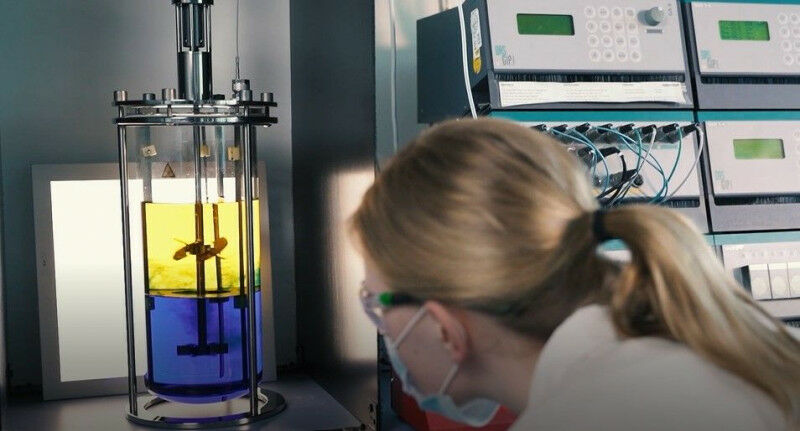
The DFG project SPP 2170 ’InterZell’, coordinated by the University of Stuttgart, presents its initial findings [Picture: Foto: University of Stuttgart/Hawkins&cross ]
The DFG project SPP 2170 'InterZell', coordinated by the University of Stuttgart, presents its initial findings [ Picture: Foto: University of Stuttgart/Hawkins&cross ] Immunoglobulins are antibodies that are generated by the immune system in answer to the sudden emergence of macromolecules. For example, these might be on the cell surface of bacteria that have infiltrated the body, or they are found in abnormal somatic cells. These play an important role in the identification and suppression of infections, such as Hepatitis A/B or Rabies, and in controlling cancer cells. But they are also markers in rapid COVID tests. There is a huge demand for such therapeutic antibodies. Under the direction of Prof. Ralf Takors and the Hamburg University of Technology (TUHH), researchers at the University of Stuttgart are currently using the immunoglobulin lgG1 to increase production using scale-up techniques. Today, biopharmaceuticals, i.e., medicines, antibiotics and vaccines obtained using biotechnology, are usually produced at an industrial scale in large bioreactors.
TO READ THIS ARTICLE, CREATE YOUR ACCOUNT
And extend your reading, free of charge and with no commitment.