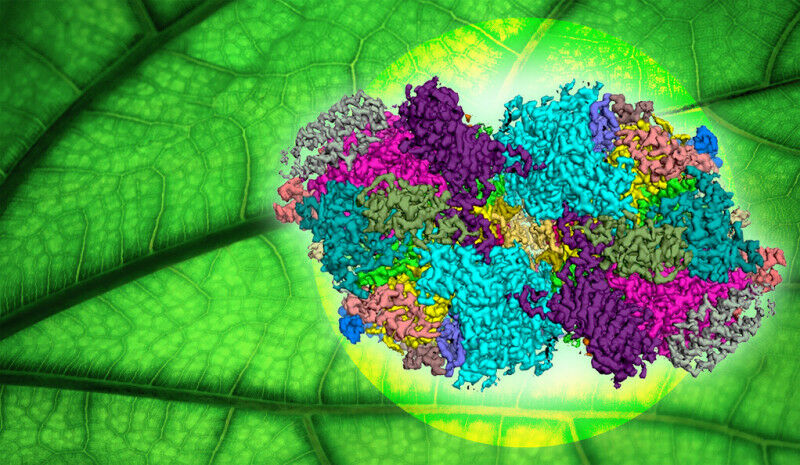
This illustration features a cryo-EM ’map’ of the photosystem II complex. It is a 3D reconstruction, based on two-dimensional cryo-EM images, with different protein subunits of the complex colored individually.
This illustration features a cryo-EM 'map' of the photosystem II complex. It is a 3D reconstruction, based on two-dimensional cryo-EM images, with different protein subunits of the complex colored individually. A Yale-led team of chemists has unveiled the blueprints for a key enzyme that may contain design principles for a new generation of synthetic solar fuel catalysts. The research, led by Yale's Gary Brudvig and Christopher Gisriel, uses cryo-electron microscopy on a microorganism called Synechocystis to get an extreme close-up picture of Photosystem II, the enzyme in photosynthesis that uses water as a solar fuel, enabling researchers to observe how the enzyme works. The study, which appears in the journal Proceedings of the National Academy of Sciences, was co-authored by researchers from the University of California-Riverside, Boston College, and City University of New York. Photosynthesis is the mechanism by which plants and certain microorganisms, like Synechocystis , use sunlight to synthesize food from carbon dioxide and water - and fill the atmosphere with oxygen as a byproduct. At the heart of photosynthesis is Photosystem II, an enzyme that oxides water molecules, taking away their electrons to use as fuel.
TO READ THIS ARTICLE, CREATE YOUR ACCOUNT
And extend your reading, free of charge and with no commitment.