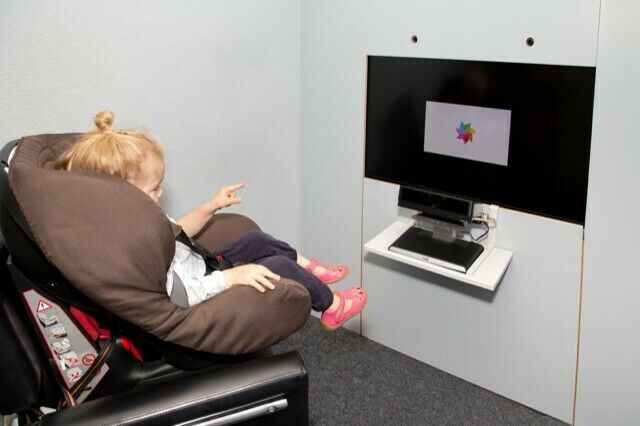
A child listening to a recording as part of the ManyBabies project. The ’listening time’ is calculated by measuring how long the child stares at a neutral stimulus. Photo: Psychology of Language Research Group, University of Göttingen
A child listening to a recording as part of the ManyBabies project. The 'listening time' is calculated by measuring how long the child stares at a neutral stimulus. Photo: Psychology of Language Research Group, University of Göttingen International research team including Göttingen University investigates babies- preference for type of speech and language A unique study of hundreds of babies across four continents shows that all babies respond more to infant-directed speech - baby talk - than they do to the type of speech directed at an adult. In fact, babies prefer baby talk in any language, but particularly when it-s in a language they-re hearing at home. An international research team including the University of Göttingen - the -ManyBabies also revealed that babies as young as six months can pick up on differences in language. The research was published in the journal Advances in Methods and Practices in Psychological Science . Adults from many cultures instinctively use a form of infant-directed speech with babies which is typically characterised as a more exaggerated way of speaking: a varied pattern of intonation, slower rate of speech with shorter, simpler words and sentences.
TO READ THIS ARTICLE, CREATE YOUR ACCOUNT
And extend your reading, free of charge and with no commitment.