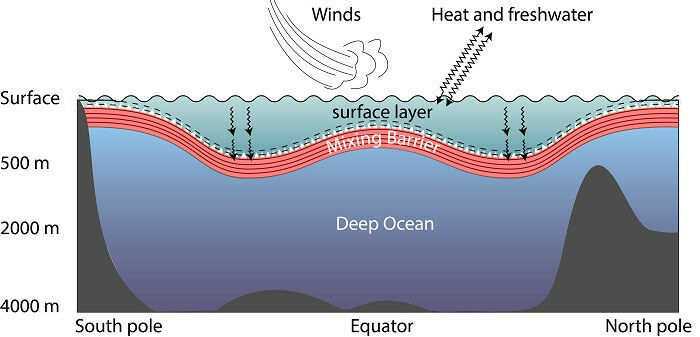
 Basic diagram of ocean’s vertical structure: the surface layer is churned by winds and absorbs atmospheric heat, which has increased due to climate change. If the ocean is to check climate change, this heat must be transmitted to its depths, far from the atmosphere. But the ocean has been stabilizing over the last 50 years, and the barrier between its surface and deeper waters is increasingly difficult to penetrate. Meanwhile, stronger winds have thickened the surface layer.
Basic diagram of ocean's vertical structure: the surface layer is churned by winds and absorbs atmospheric heat, which has increased due to climate change. If the ocean is to check climate change, this heat must be transmitted to its depths, far from the atmosphere. But the ocean has been stabilizing over the last 50 years, and the barrier between its surface and deeper waters is increasingly difficult to penetrate. Meanwhile, stronger winds have thickened the surface layer. Jean-Baptiste Sallée, LOCEAN (CNRS / MNHN / IRD / Sorbonne University)
-A
+A - The ocean is dynamic in nature, playing a crucial role as a planetary thermostat that buffer global warming. However, in response to climate change, the ocean has generally become stabler over the past 50 years. Six times stabler, in fact, than previously estimated-as shown by a new study that researchers from the CNRS, Sorbonne University, and IFREMER have conducted within the scope of an international collaboration.
TO READ THIS ARTICLE, CREATE YOUR ACCOUNT
And extend your reading, free of charge and with no commitment.
Your Benefits
- Access to all content
- Receive newsmails for news and jobs
- Post ads