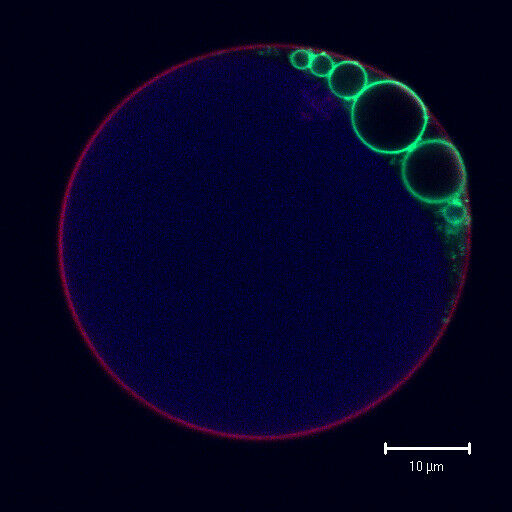
A cell from the epidermis of a petal from a petunia flower. The outer cell membrane is labelled in red, the central vacuole is filled wih anthocyanins resulting in the blue colour and vacuolinos are marked in green (Copyright: UvA).
A cell from the epidermis of a petal from a petunia flower. The outer cell membrane is labelled in red, the central vacuole is filled wih anthocyanins resulting in the blue colour and vacuolinos are marked in green (Copyright: UvA). Sometimes plant cells don't have just one large central cavity, or vacuole, but several. These can even have different functions. How is that possible? A team led by UvA biologists Ronald Koes and Francesca Quattrocchio took another step towards solving this fundamental biological riddle. Their discovery has been published in the leading scientific journal Cell Reports. If you open a random book on biology and look up a picture of a plant cell, you will see that there is always a large cavity in the middle of these cells. This is the vacuole. It is an important cellular storage place in which plants can store all kinds of substances. The vacuole contains both reserve nutrients and waste products, vacuoles in the cells on the surface of flowers contain pigments that determine the flower colour, in fruits they contain the acids and sugars that give the fruits their taste, plants growing in salty conditions can store excess salt in vacuoles, and so on. Thus far this seems pretty straight forward. Biological riddle. 'But, about twenty years ago it was discovered that some plant cells have multiple vacuoles. And that these can also have very different functions,' says Ronald Koes. 'Since then, the big question is how this is possible. How do these additional vacuoles form?
TO READ THIS ARTICLE, CREATE YOUR ACCOUNT
And extend your reading, free of charge and with no commitment.