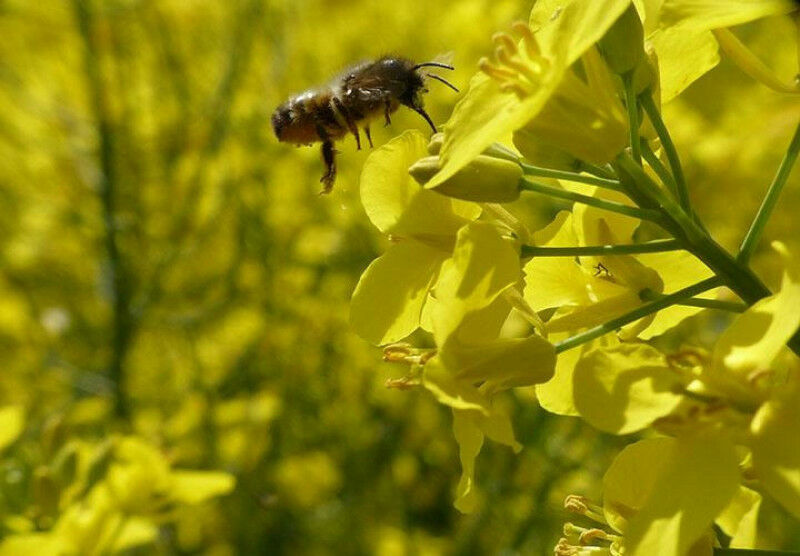
Solitary wild bee on an oilseed rape flower Photo: N Beyer
Solitary wild bee on an oilseed rape flower Photo: N Beyer Research team investigates influence of different mass-flowering crops on pollinators Mass-flowering crops such as oilseed rape or faba bean (also known as broad bean) provide valuable sources of food for bees, which, in turn, contribute to the pollination of both the crops and nearby wild plants when they visit. But not every arable crop that produces flowers is visited by the same bees. A team from the University of Göttingen and the Julius Kühn Institute (JKI) in Braunschweig has investigated how the habitat diversity of the agricultural landscape and the cultivation of different mass-flowering crops affect wild bees. The research shows that diverse agricultural landscapes increase the species richness of wild bees. Flowering arable crops with different flower shapes support different wild bee species. The results of the study have been published in Landscape Ecology . The research team recorded wild bees in flower-rich, semi-natural habitats such as hedgerows and flower strips in a total of 30 different agricultural landscapes, each covering one square kilometre, near Göttingen, Itzehoe and Leipzig.
TO READ THIS ARTICLE, CREATE YOUR ACCOUNT
And extend your reading, free of charge and with no commitment.