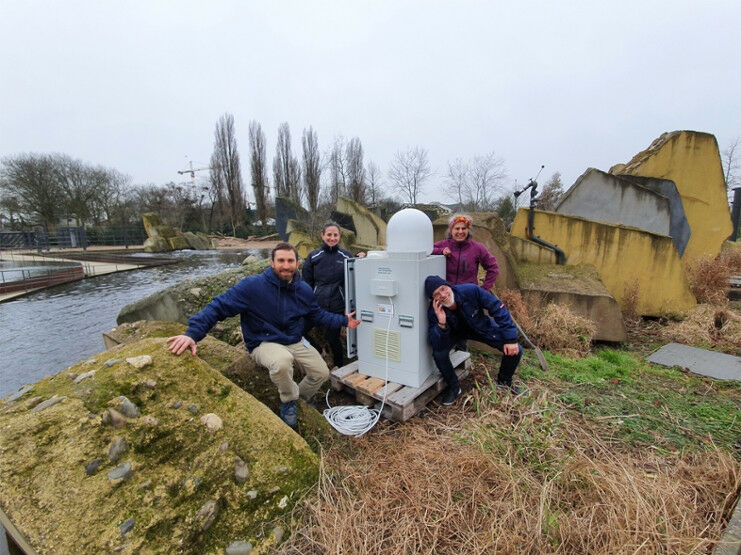
The placement of the BirdScan in the elephant enclosure in ARTIS by, from left to right, Dr Leonardo Porcacchia (UvA), Rotem Kadan-Zilber (UvA), Ton Hilhorst (ARTIS) and Prof. Judy Shamoun-Baranes (UvA). Photo J. Shamoun-Baranes.
The placement of the BirdScan in the elephant enclosure in ARTIS by, from left to right, Dr Leonardo Porcacchia (UvA), Rotem Kadan-Zilber (UvA), Ton Hilhorst (ARTIS) and Prof. Judy Shamoun-Baranes (UvA). Photo J. Shamoun-Baranes. Researchers of the University of Amsterdam have installed a BirdScan radar at the elephant enclosure in ARTIS Amsterdam Royal Zoo to record bird migration. This BirdScan radar is part of the first site of the national research project ARISE that has the ultimate aim to monitor biodiversity in the Netherlands. Wednesday,10 March Prof. Judy Shamoun-Baranes, Rotem Kadan-Zilber and Dr Leonardo Porcacchia from the UvA Institute for Biodiversity and Ecosystem Dynamics (IBED) moved a BirdScan radar to the elephant enclosure in ARTIS Zoo. Here, it serves two purposes; it will be used to record bird migration, and it will be used as part of a demonstration site to show visitors of the zoo different systems used for remotely monitoring biodiversity. This way the visitors can learn about several sensors which can be used to measure biodiversity, of which the radar is one.
TO READ THIS ARTICLE, CREATE YOUR ACCOUNT
And extend your reading, free of charge and with no commitment.