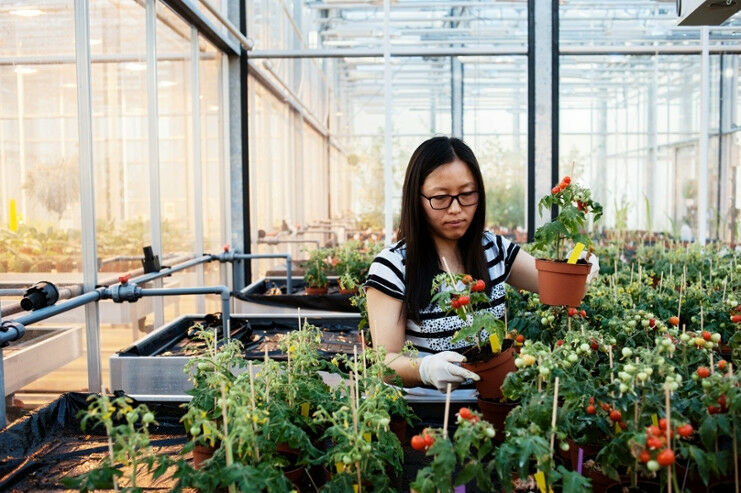
Amongst the crops that are studied in the greenhouses of the University of Amsterdam are tomatoes.
Amongst the crops that are studied in the greenhouses of the University of Amsterdam are tomatoes. A revolutionary method to make crops more resilient to climate change and other threats is one step closer to becoming reality. A team of universities and companies has been given the green light by the Dutch Research Council (NWO) to further develop a plan for this. With a budget of 50 million euros, the team aims connect specialists in plant sciences, data sciences, artificial intelligence (AI) and breeding companies over the next ten years on a method to develop agricultural crops that can be grown in climate-proof and sustainable manner. The climate is changing, and our crops have to keep up with it. A team of scientists and companies are joining forces to learn how to make crops more resilient to heat, drought, pests and diseases; also because we want to use less pesticides in the future. In their ten year plan called Plant-XR, the team aims to enable the development of new climate resilient crops with the help of artificial intelligence and computer models.
TO READ THIS ARTICLE, CREATE YOUR ACCOUNT
And extend your reading, free of charge and with no commitment.