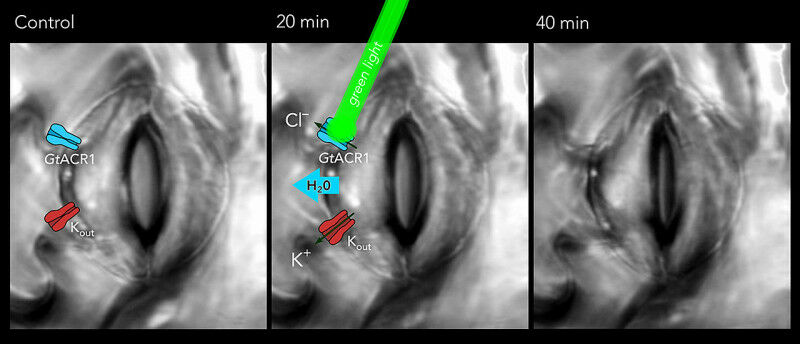
Remote control for stomatal movement. Green light can activate the GtACR1 channel in guard cells that surround an open pore (left). Active GtACR1 channels release chloride ions, which automatically also causes the efflux of potassium ions and the release of water (middle). Because of slackening of the guard cells the stomatal pores in the leaf surface close (right). (Image: Lehrstuhl für Botanik I / Universität Würzburg)
Remote control for stomatal movement. Green light can activate the GtACR1 channel in guard cells that surround an open pore ( left ). Active GtACR1 channels release chloride ions, which automatically also causes the efflux of potassium ions and the release of water ( middle ). Because of slackening of the guard cells the stomatal pores in the leaf surface close ( right ). (Image: Lehrstuhl für Botanik I / Universität Würzburg) - Plant researchers have a potent new tool at disposal: Advances, a research team from Würzburg shows how to close the stomata of leaves using light pulses. Plants have microscopically small pores on the surface of their leaves, the stomata. With their help, they regulate the influx of carbon dioxide for photosynthesis.
TO READ THIS ARTICLE, CREATE YOUR ACCOUNT
And extend your reading, free of charge and with no commitment.