Dr Jun Peng and Associate Thomas White
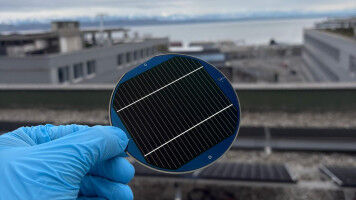
Dr Jun Peng and Associate Thomas White - A new study shows how researchers at The Australian National University (ANU) achieved a world record in solar cell efficiency. The study focused on perovskite solar cells - made using a special group of materials which are cheap and easy to manufacture. The group achieved 21.6 per cent efficiency in converting sunlight into electricity, a new record for perovskite solar cells larger than one square centimetre in size. According to lead researcher Associate Professor Tom White, they managed to achieve this breakthrough by adapting a technique which has already proven successful with silicon solar cells. "A common problem with solar cells is that any defects in the cell can trap electrons, taking away the energy they gained by absorbing sunlight," Associate Professor White said. "A way around this is to "passivate" the surface by coating the light absorbing material with a thin layer of another material to reduce defects. But the materials used to reduce defects are often poor conductors of electricity. Dr Jun Peng, who proposed the solution to this problem, explained that "some silicon cells use holes to let the electrons through this insulating layer, creating a kind of conductive pathway.
TO READ THIS ARTICLE, CREATE YOUR ACCOUNT
And extend your reading, free of charge and with no commitment.