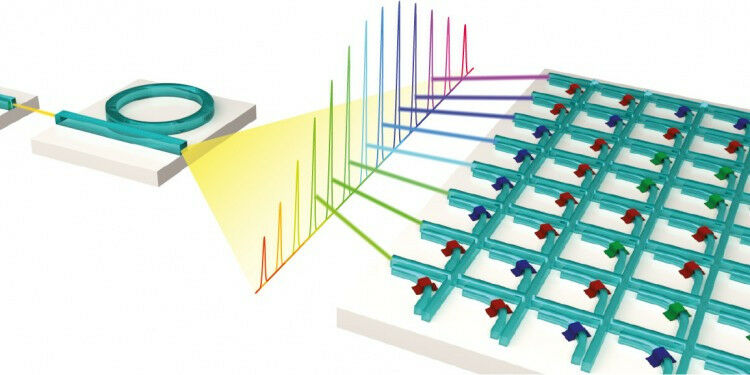
 Schematic representation of a processor for matrix multiplications which runs on light. Together with an optical frequency comb, the waveguide crossbar array permits highly parallel data processing.
Schematic representation of a processor for matrix multiplications which runs on light. Together with an optical frequency comb, the waveguide crossbar array permits highly parallel data processing. WWU/AG Pernice In the digital age, data traffic is growing at an exponential rate. The demands on computing power for applications in artificial intelligence such as pattern and speech recognition in particular, or for self-driving vehicles, often exceeds the capacities of conventional computer processors. Working together with an international team, researchers at the University of Münster are developing new approaches and process architectures which can cope with these tasks extremely efficient. They have now shown that so-called photonic processors, with which data is processed by means of light, can process information much more rapidly and in parallel - something electronic chips are incapable of doing. The results have been published in the "Nature? journal.
TO READ THIS ARTICLE, CREATE YOUR ACCOUNT
And extend your reading, free of charge and with no commitment.
Your Benefits
- Access to all content
- Receive newsmails for news and jobs
- Post ads