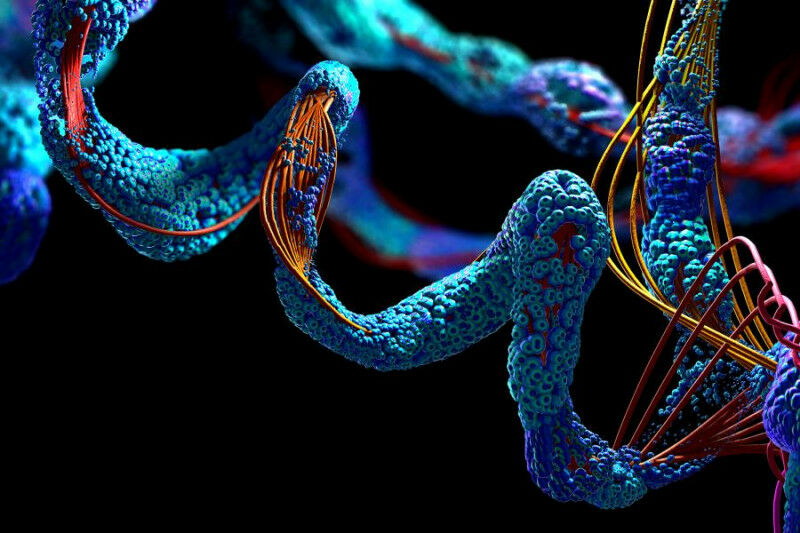
An illustration of DNA strands
A team led by Hopkins engineer Rebecca Schulman has developed a library of genelets that can perform certain cellular functions, laying the groundwork for materials that behave like organisms. An illustration of DNA strands - Our bodies' genes work together to regulate how our cells behave. For example, if you skin your knee, your genes use a chemical messaging system to direct an army of cells to heal the abrasion. If scientists could create artificial genes that could carry out the same functions but operate inside materials rather than organisms, a wide variety of new diagnostic, self-healing materials would be possible. A team led by Johns Hopkins engineer Rebecca Schulman is laying the foundation for that work by engineering synthetic chemical systems that can emulate the complex behaviors of natural gene networks. Their work recently appeared in Nature Chemistry . "Cells use genes to decide how to move, grow, and act.
TO READ THIS ARTICLE, CREATE YOUR ACCOUNT
And extend your reading, free of charge and with no commitment.