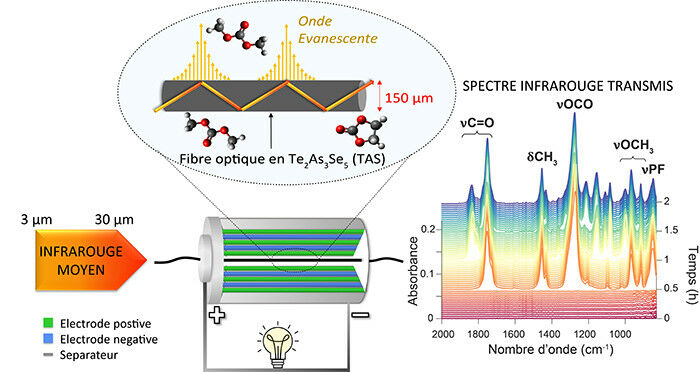
 The propagation of infrared light through the core of optical glass fibres with composition Te2As3Se5 (TAS). On the surface of the fibre, an evanescent wave is created and can interact with the surrounding molecules. The TAS fibre is passed through the centre of a type 18650 battery. The chemical bonds corresponding to the electrolyte can thus be observed during its use.
The propagation of infrared light through the core of optical glass fibres with composition Te2As3Se5 (TAS). On the surface of the fibre, an evanescent wave is created and can interact with the surrounding molecules. The TAS fibre is passed through the centre of a type 18650 battery. The chemical bonds corresponding to the electrolyte can thus be observed during its use. Gervillié-Mouravieff et al./Collège de France Controlling and studying the chemistry of batteries is crucial to improving their design. Scientists have developed an optical fibre based method for monitoring the evolving chemistry of a commercial battery in real time during charging and discharging. These results pave the way for easier and improved battery design.
TO READ THIS ARTICLE, CREATE YOUR ACCOUNT
And extend your reading, free of charge and with no commitment.
Your Benefits
- Access to all content
- Receive newsmails for news and jobs
- Post ads