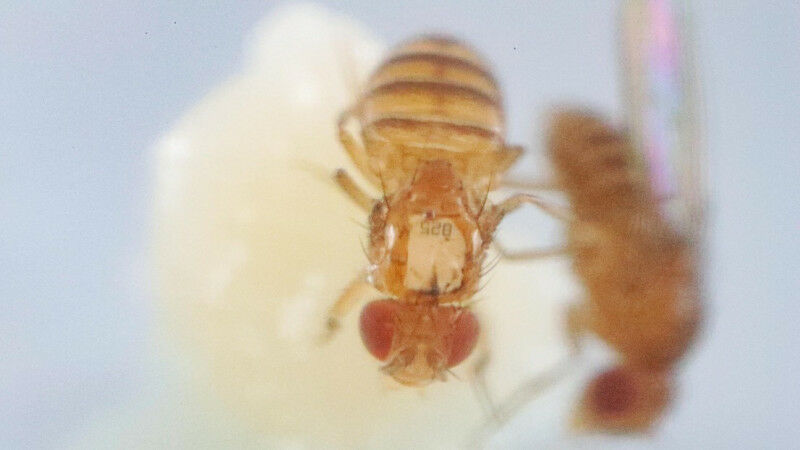
An implanted Drosophila melanogaster fruit fly (foreground) interacting with an intact one (background). Credit: Alain Herzog (EPFL)
An implanted Drosophila melanogaster fruit fly (foreground) interacting with an intact one (background). Credit: Alain Herzog (EPFL) - Scientists at EPFL have developed an implantation technique that allows unprecedented optical access to the "spinal cord" of the fruit fly, Drosophila melanogaster. This work can potentially lead to breakthroughs in the fields of neuroscience, artificial intelligence, and bio-inspired robotics. Understanding biological motor control requires the ability to record neural activity while animals are behaving," says Professor Pavan Ramdya at EPFL's School of Life Sciences. "We have a billion neurons in the human spinal cord - a massive system - and we can't manipulate neurons in a human the way that we can with animals. Drosophila , the fruit fly, is a very small organism in which one can genetically manipulate and image the activity of nearly the entire motor circuitry in behaving animals." For years, Ramdya's research has focused on digitally recapitulating the principles underlying Drosophila motor control. In 2019, his group published DeepFly3D , a deep-learning based motion-capture software that uses multiple camera views to quantify the 3D limb movements of behaving flies.
TO READ THIS ARTICLE, CREATE YOUR ACCOUNT
And extend your reading, free of charge and with no commitment.