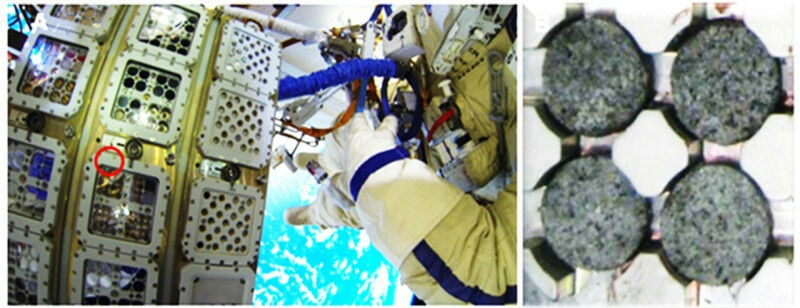
Section of the EXPOSE-2 platform outside the International Space Station (ISS) simulating a Mars-like environment Photo: European Space Agency (ESA)
Section of the EXPOSE-2 platform outside the International Space Station (ISS) simulating a Mars-like environment Photo: European Space Agency (ESA) Research team including Göttingen University studies kombucha cultures under extraterrestrial conditions An international research team including the University of Göttingen has investigated the chances of survival of kombucha cultures under Mars-like conditions. Kombucha is known as a drink, sometimes called tea fungus or mushroom tea, which is produced by fermenting sugared tea using kombucha cultures - a symbiotic culture of bacteria and yeast. Although the simulated Martian environment destroyed the microbial ecology of the kombucha cultures, surprisingly, a cellulose-producing bacterial species survived. The results were published in Frontiers in Microbiology . The scientists of the "Biology and Mars Experiment" (BIOMEX) project had already sent kombucha cultures to the International Space Station (ISS) in 2014 with the support of the European Space Agency. The aim was to learn more about the robustness of cellulose as a biomarker, the genomic architecture of kombucha, and its survival behaviour under extraterrestrial conditions. After one and a half years under simulated Martian conditions outside the ISS, the samples were reactivated on Earth and cultivated for another two and a half years.
TO READ THIS ARTICLE, CREATE YOUR ACCOUNT
And extend your reading, free of charge and with no commitment.