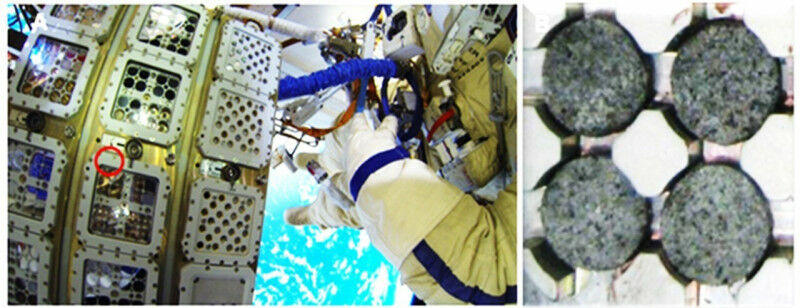
Section of the EXPOSE-2 platform outside the ISS simulating a Mars-like environment (A) and section of the EXPOSE-2 platform with the kombucha cultures in a biofilm (B). Photo: ESA
Section of the EXPOSE-2 platform outside the ISS simulating a Mars-like environment (A) and section of the EXPOSE-2 platform with the kombucha cultures in a biofilm (B). Photo: ESA Research team studies kombucha cultures under extraterrestrial conditions An international research team with participation from the University of Göttingen has investigated the survival of kombucha cultures under Mars-like conditions. Kombucha cultures are also known as tea fungi and are used to produce beverages. Although the simulated Martian environment destroyed the microbial ecology of the kombucha cultures, surprisingly, one cellulose-producing bacterial species survived. The results appeared in the journal Frontiers in Microbiology . The scientists of the -Mission Biology and Mars Experiment- (Biomex) project had already sent kombucha cultures to the International Space Station ISS in 2014 with the support of the European Space Agency ESA. The goal was to learn more about the robustness of cellulose as a biosignature-the genomic architecture of kombucha fungi-and resistance behavior under extraterrestrial conditions.
TO READ THIS ARTICLE, CREATE YOUR ACCOUNT
And extend your reading, free of charge and with no commitment.