Credit: Pablo Maceira-Elvira (EPFL)
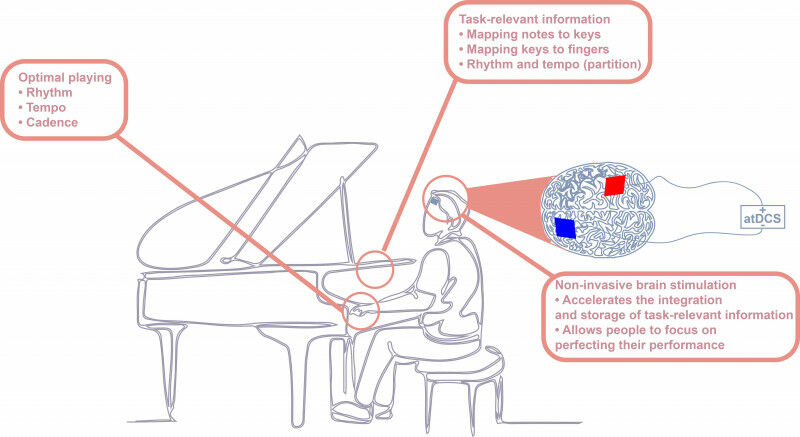
Credit: Pablo Maceira-Elvira (EPFL) - Non-invasive brain stimulation can restore optimal motor skill acquisition in people with diminished learning capabilities, e.g. due to age. The study was carried out by scientists at EPFL. Even though we don't think about it, every movement we make in our daily life essentially consists of a sequence of smaller actions in a specific order. The only time we realize this is when we have to learn a new motor skill, like a sport, a musical instrument, a new dance routine or even a new electronic device such as a smart phone or videogame controller. Perhaps unsurprisingly, there is a lot of research invested in figuring out how humans acquire sequential motor skills, with a majority of studies in healthy young adults. Studies involving older individuals (and common experience) show that the older we get, the harder it is and the longer it takes to learn new motor skills, suggesting an age-related decrease in learning ability. "As learning is crucial for continuously adapting and staying integrated in daily life, improving these impaired functions will help to maintain the quality of life as we age, especially in view of the constant increase in life expectancy seen worldwide," says Professor Friedhelm Hummel who holds the Defitech Chair of Clinical Neuroengineering at EPFL's School of Life Sciences.
TO READ THIS ARTICLE, CREATE YOUR ACCOUNT
And extend your reading, free of charge and with no commitment.