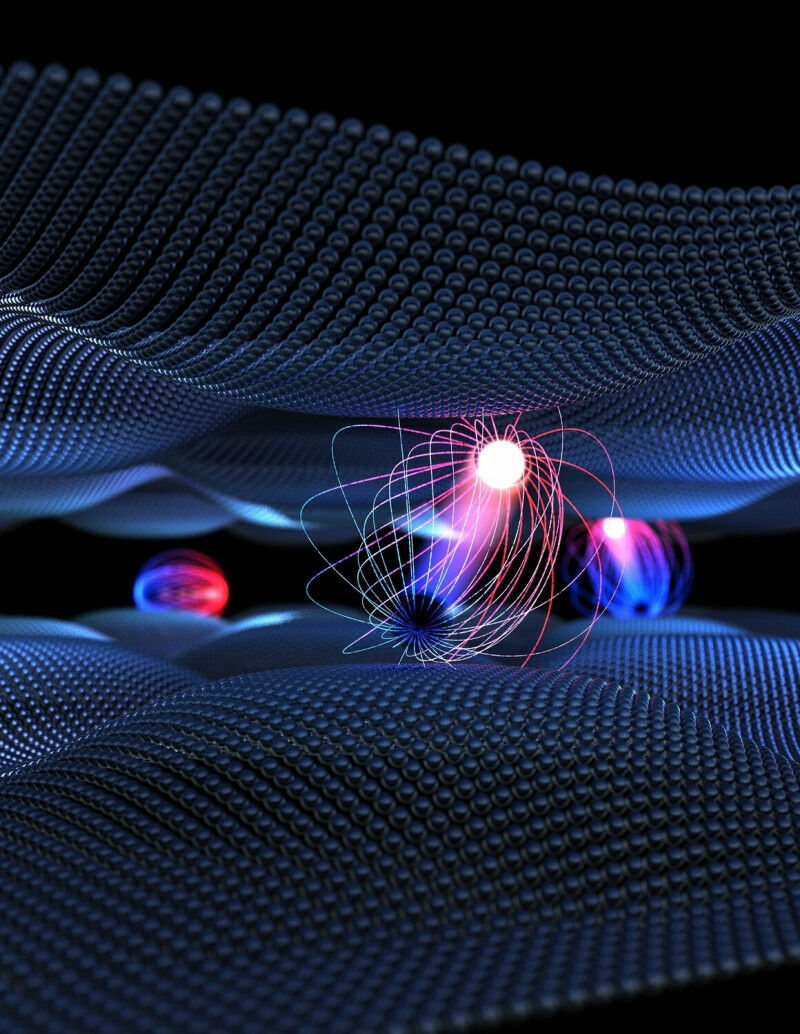
Artistic representation showing the twisted layers of tungsten diselenide (top) and molybdenum disulphide (bottom). Following excitation using light, a multitude of optically ’dark’ excitons form between the layers. These ’dark’ excitons are electron-hole pairs bound by Coulomb interaction (light and dark spheres connected by field lines), which cannot be directly observed using visible light. One of the most interesting quasiparticles is the ’moiré interlayer exciton’ - shown in the middle of the image - in which the hole is located in one layer and the electron in the other. The formation of these excitons on the femtosecond time scale and the influence of the Moiré potential (illustrated by peaks and troughs in the layers) were investigated in the current study using femtosecond photoemission momentum microscopy and quantum mechanical theory. Photo: Brad Baxley, Part to Whole, LLC
Artistic representation showing the twisted layers of tungsten diselenide ( top ) and molybdenum disulphide ( bottom ). Following excitation using light, a multitude of optically 'dark' excitons form between the layers. These 'dark' excitons are electron-hole pairs bound by Coulomb interaction (light and dark spheres connected by field lines), which cannot be directly observed using visible light. One of the most interesting quasiparticles is the 'moiré interlayer exciton' - shown in the middle of the image - in which the hole is located in one layer and the electron in the other. The formation of these excitons on the femtosecond time scale and the influence of the Moiré potential (illustrated by peaks and troughs in the layers) were investigated in the current study using femtosecond photoemission momentum microscopy and quantum mechanical theory. Photo: Brad Baxley, Part to Whole, LLC Research team led by Göttingen University observes formation of "dark" moiré interlayer excitons for the first time An international research team led by the University of Göttingen has, for the first time, observed the build-up of a physical phenomenon that plays a role in the conversion of sunlight into electrical energy in 2D materials. The scientists succeeded in making quasiparticles - known as dark Moiré interlayer excitons - visible and explaining their formation using quantum mechanics.
TO READ THIS ARTICLE, CREATE YOUR ACCOUNT
And extend your reading, free of charge and with no commitment.