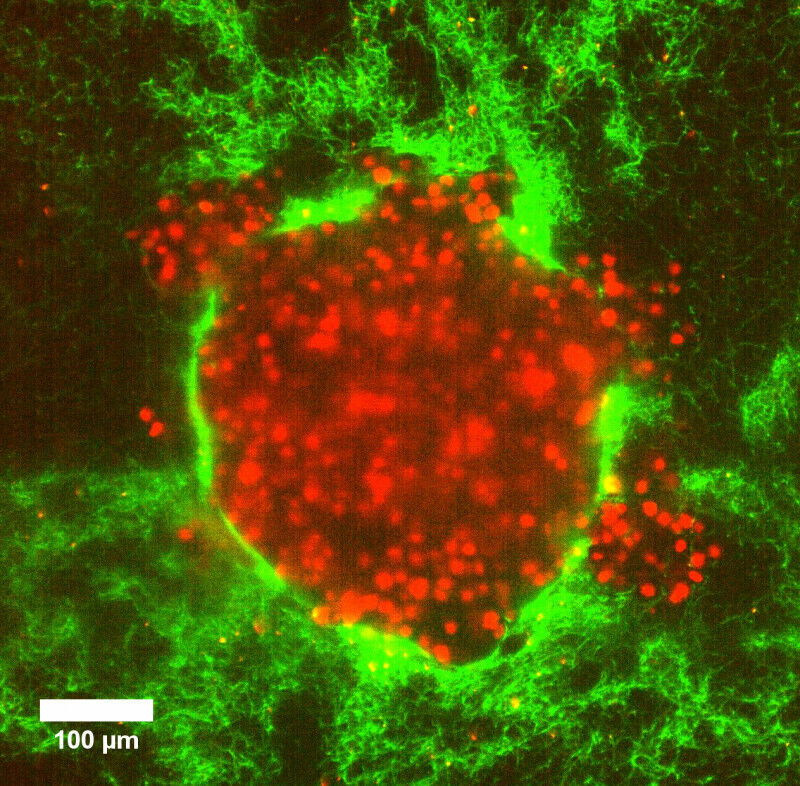
Tumour model using clumps of cancer cells (their nuclei are marked red) in a soft 3-D matrix of collagen. Pressure causes the cancer cells to burst rapidly into the surrounding soft matrix. Photo: Dr Swetha Raghuraman
Tumour model using clumps of cancer cells (their nuclei are marked red) in a soft 3-D matrix of collagen. Pressure causes the cancer cells to burst rapidly into the surrounding soft matrix. Photo: Dr Swetha Raghuraman Researchers led by Göttingen University discover phenomenon to help explain cancer metastasis Biological processes such as wound healing and cancer cell invasion rely on the collective and coordinated motion of living cells. A little understood aspect that influences these processes is the pressure differences within and between different parts of the body. Researchers from Göttingen University and Münster University designed model tumour systems using cervical cancer cells in collagen matrices to investigate whether pressure differences can push cancer cells into their surroundings. Upon embedding the model tumours into a soft matrix, an increased pressure led to a sudden burst of rapid and coordinated cellular motion that sprayed outwards from the tumour. Their results were published in Advanced Science .
TO READ THIS ARTICLE, CREATE YOUR ACCOUNT
And extend your reading, free of charge and with no commitment.