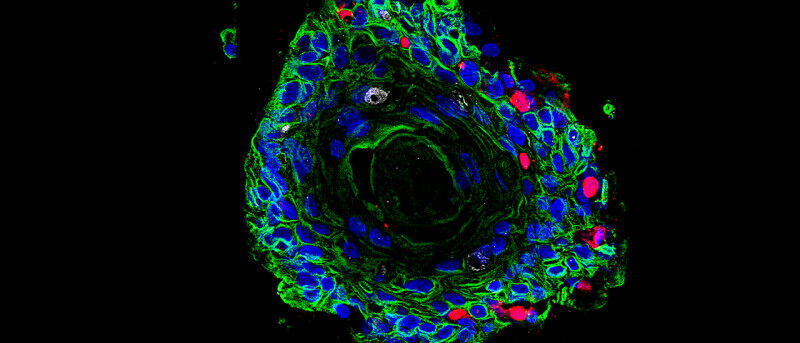
Image of patient-derived ectocervical stratified squamous organoids (Green) infected with Chlamydia trachomatis (red). (Image: AG Chumduri)
Image of patient-derived ectocervical stratified squamous organoids ( Green ) infected with Chlamydia trachomatis ( red ). (Image: AG Chumduri) 02/24/2022 - Infections with several pathogens simultaneously increase the risk of cervical cancer-these results from a study conducted on artificial 3D tissue models. Patients who develop cervical cancer are often infected not only with the human papillomavirus (HPV) but also simultaneously with the bacterial pathogen Chlamydia trachomatis . The suspicion is, therefore, that the two pathogens work together in a kind of team to "reprogram" the cells they infect in such a way that they degenerate and multiply uncontrollably. Dr. Cindrilla Chumduri, head of the research group, Department of Microbiology at the Julius Maximilians University of Würzburg (JMU) and her team, has now demonstrated for the first time that this is not just a suspicion but a concretely verifiable effect. They have developed lifelike organ replicas - so-called 3D organoids - on which they investigate the interactions between the pathogens and the tissues they affect and the disease processes. She has published the results of her research Communications.
TO READ THIS ARTICLE, CREATE YOUR ACCOUNT
And extend your reading, free of charge and with no commitment.