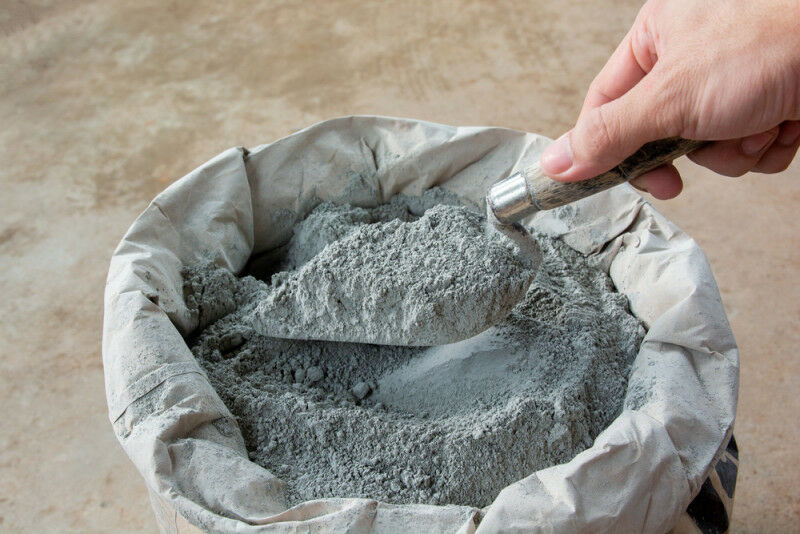
(© Image: Depositphotos) - Scientists from EPFL and the University of Lausanne have used a chip that was originally designed for environmental science to study the properties of biocement formation. This material has the potential to replace traditional cement binders in certain civil engineering applications. The chip has the size of a credit card and its surface is engraved with a flow channel measuring one meter from end to end and as thick as a human hair. Researchers can inject a solution into one end of the channel and, with the help of time-lapse microscopy, observe the solution's behavior over several hours. Medical scientists have used similar chips for healthcare applications, such as to examine how arteries get clogged or how a drug spreads into the bloodstream, while environmental engineers have applied them to the study of biofilms and contaminants in drinking water. Now, a team of civil engineers at EPFL's Laboratory of Soil Mechanics (LMS), together with scientists from the Faculty of Geosciences and Environment at the University of Lausanne (UNIL), have repurposed the chip to understand complex transport-reaction phenomena involved in the formation of new kinds of biocement. Ariadni Elmaloglou, a PhD candidate, together with Dimitrios Terzis, one of her thesis supervisors from EPFL's Laboratory of Soil Mechanics (LMS), injected biocement solutions into microfluidic chips resembling different types of sand to see how the minerals form and the flow responds.
TO READ THIS ARTICLE, CREATE YOUR ACCOUNT
And extend your reading, free of charge and with no commitment.
Your Benefits
- Access to all content
- Receive newsmails for news and jobs
- Post ads