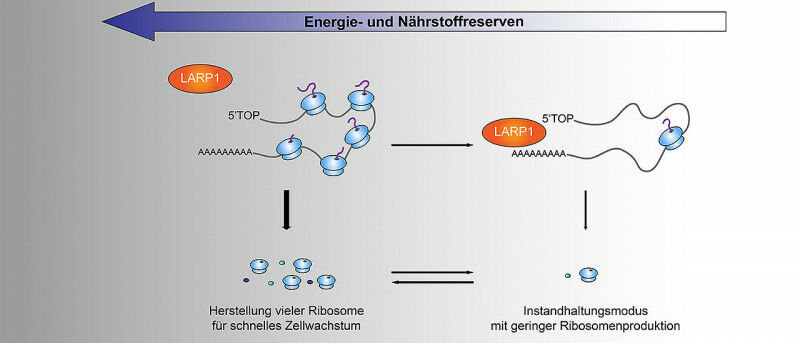
Cells probably require up to 50 percent of their energy reserves for ribosome production. Under nutrient deficiency, the LARP1 protein ensures that protein production is reduced.
Cells probably require up to 50 percent of their energy reserves for ribosome production. Under nutrient deficiency, the LARP1 protein ensures that protein production is reduced. How do cells manage to quickly adapt their growth to changing environmental conditions? A new study by a research team from Würzburg provides an answer to this question. Regardless of whether it is a single-celled organism or a mammal, a plankton, or a sequoia: growth is a basic principle of all life on this earth. And the starting point of this growth is usually the cell: for this to happen, it must double its components and ingredients within a short time so that it can then divide and set growth in motion. The process behind this is complicated and has not yet been deciphered down to the last detail. Now, however, a research team from Würzburg has succeeded in identifying a key mechanism in this process.
TO READ THIS ARTICLE, CREATE YOUR ACCOUNT
And extend your reading, free of charge and with no commitment.