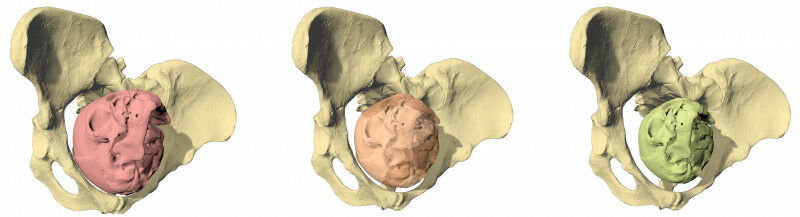
Birth simulation of Lucy (Australopithecus afarensis) with three different fetal head sizes. Only a brain size of maximum 30 percent of the adult size (right) fits through the birth canal. (Picture: Martin Häusler, UZH)
Birth simulation of Lucy (Australopithecus afarensis) with three different fetal head sizes. Only a brain size of maximum 30 percent of the adult size ( right ) fits through the birth canal. (Picture: Martin Häusler, UZH) - Childbirth in humans is much more complex and painful than in great apes. It was long believed that this was a result of humans- larger brains and the narrow dimensions of the mother's pelvis. Researchers at the University of Zurich have now used 3D simulations to show that childbirth was also a highly complex process in earlier hominin species that gave birth to relatively small-brained newborns - with important implications for their cognitive development. During human birth, the fetus typically navigates a tight, convoluted birth canal by flexing and rotating its head at various stages. This complex process comes with a high risk of birth complications, from prolonged labor to stillbirth or maternal death.
TO READ THIS ARTICLE, CREATE YOUR ACCOUNT
And extend your reading, free of charge and with no commitment.