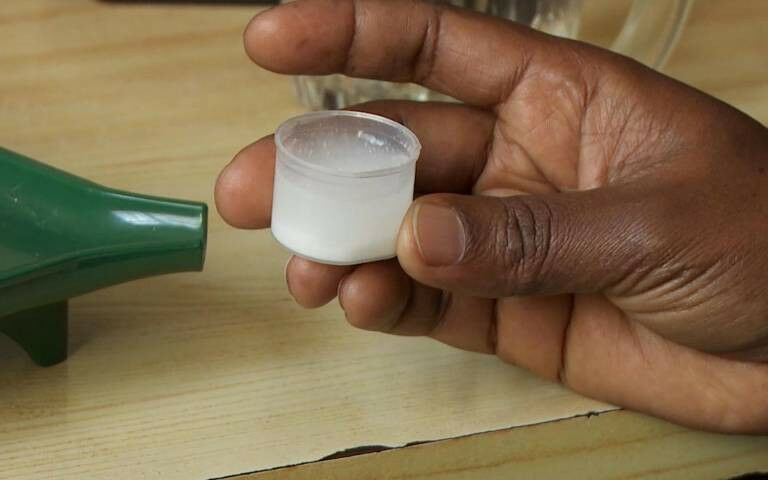
Dispersible medicine in a cup
Dispersible medicine in a cup - A once-a-day antiretroviral medicine that is low-cost and easy for children to take is also more effective at suppressing HIV than standard treatments, according to a global trial led by researchers at UCL. The study, published today in The New England Journal of Medicine , found that dolutegravir-based regimens, which are already widely used to treat adults, reduced the chances of treatment failure among young people aged three to 18 by around 40% compared to standard treatments. The findings were based on a randomised controlled trial called ODYSSEY involving more than 700 children from 29 clinical centres in Africa, Europe and Asia, who were randomly given either dolutegravir or standard anti-HIV drugs, and who were followed up for at least two years. The findings from the trial, which was sponsored by the Penta Foundation and funded by ViiV Healthcare, informed new guidance by the World Health Organisation, recommending the use of dolutegravir-based treatment for children. Professor Diana Gibb (MRC Clinical Trials Unit at UCL), principal investigator of the ODYSSEY trial and one of the senior authors of the paper, said: "Our findings provide strong evidence for the global roll-out of dolutegravir for children with HIV. "Medical treatments for children often lag woefully behind those of adults because of the separate formulations and studies that are needed.
TO READ THIS ARTICLE, CREATE YOUR ACCOUNT
And extend your reading, free of charge and with no commitment.