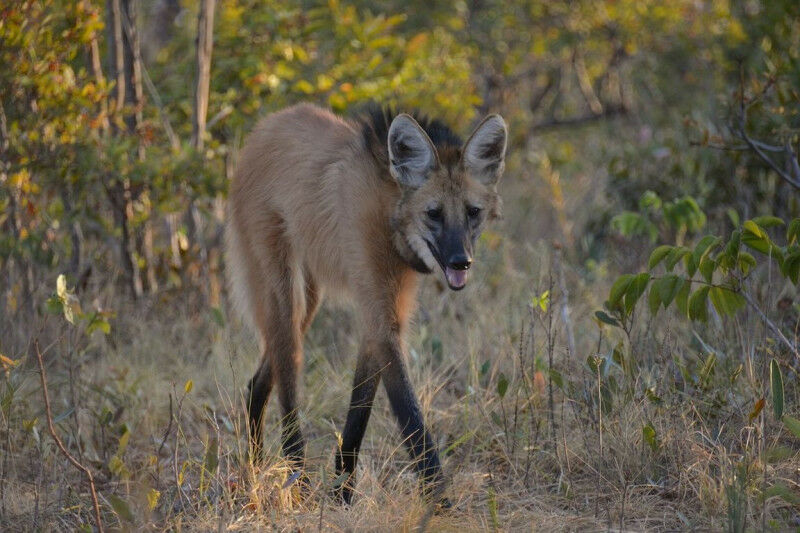
Rogério Cunha de Paula The maned wolf, the tallest and longest-legged canid in South America, is most closely related to the shortest, the bush dog (pictured below), researchers found.
Rogério Cunha de Paula The maned wolf, the tallest and longest-legged canid in South America, is most closely related to the shortest, the bush dog (pictured below), researchers found. Canid conundrum. Upending long-held assumptions, researchers found that a single doglike species that entered South America less than 4 million years ago gave rise to all of today's canid species. Speedy speciation. Within a span of 2 million years, the blink of an eye in evolutionary time, all 10 existing species and some that are now extinct evolved from that original group. How did it happen? The research demonstrates just how rapidly new species can arise and spread out geographically in environments where there is little competition. South America has more canid species than any place on Earth, and a surprising new UCLA-led genomic analysis shows that all these doglike animals evolved from a single species that entered the continent just 3.5 million to 4 million years ago.
TO READ THIS ARTICLE, CREATE YOUR ACCOUNT
And extend your reading, free of charge and with no commitment.