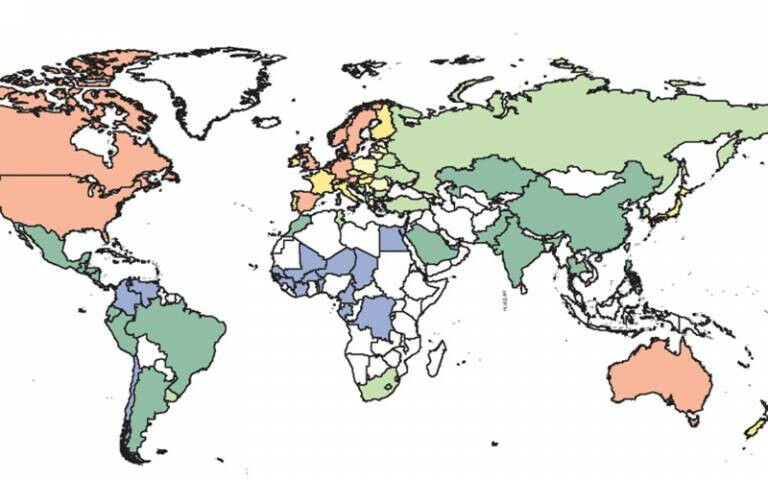
Map showing opioid consumption by country - Map from the research paper showing opioid consumption by country (highest in red, lowest in blue).
Map showing opioid consumption by country - Map from the research paper showing opioid consumption by country (highest in red, lowest in blue) . Global opioid sales increased by an estimated 4% annually from 2015 to 2019, but massive disparities in access to essential pain relief medications persist between countries, finds a study led by UCL researchers. Opioid use in some countries in Africa and South America was less than one tenth of 1% of the rates in wealthier countries in North America, Europe and Australia, according to the findings published in The Lancet Public Health . Some countries are starting to catch up, as the overall picture is one of gradual geographic convergence in opioid consumption. North America has seen a decline in opioid use, likely the result of efforts to reduce inappropriate prescribing to curb deadly opioid misuse, so multiple European countries, led by Switzerland, Germany, and Spain, have surpassed the United States in opioid sales. Lead author Dr Wallis Lau (UCL School of Pharmacy) said: "We found that while there is some improvement in a lot of countries, there are still concerningly low rates of opioid use in large parts of the world, even in numerous middle-income countries. "Opioids have been listed by the World Health Organization as an essential class of medicine for acute pain, cancer-related pain, and palliative care since 1977, so it is troubling that in many parts of the world, people are unable to access this medicine.
TO READ THIS ARTICLE, CREATE YOUR ACCOUNT
And extend your reading, free of charge and with no commitment.