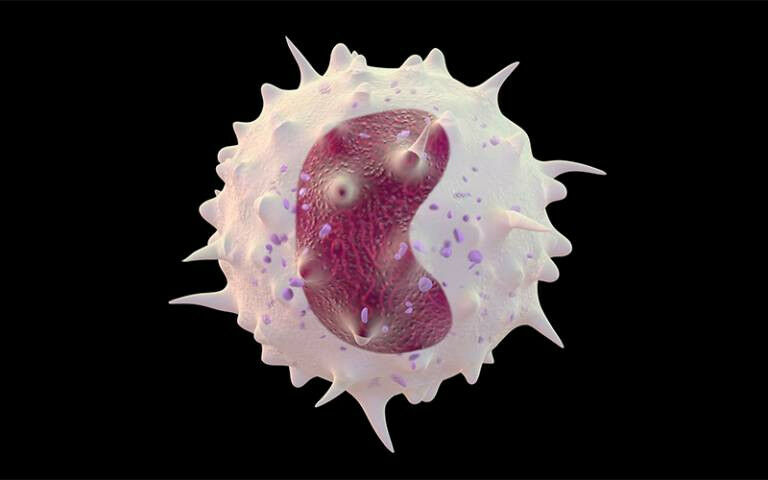
Monocyte white blood cell - Credit: Gaetan Stoffel on iStock
Monocyte white blood cell - Credit: Gaetan Stoffel on iStock - The reasons why Covid-19 causes severe inflammation in some people, leading to acute respiratory distress and multi-organ damage, has been revealed in a new study involving a UCL scientist. Published in Nature , the study led by researchers at Boston Children's Hospital (US) , found evidence that the virus might activate inflammasomes, large molecules that trigger a cascade of inflammatory responses that ends in cell death. Additionally, they found that certain antibodies developed during SARS-CoV-2 infection, but not following mRNA vaccination, can sometimes lead to more severe inflammation. Co-author Dr Gautam Mehta (UCL Institute for Liver & Digestive Health) said: "During the early days of the pandemic, the emerging data suggested cell death was likely a key part of the disease process in severe Covid-19. As it happened, the 'pyroptosis' mode of cell death, and its role in liver disease, was already an area of interest of our group. Pyroptosis is a pro-inflammatory mode of cell death, since it releases an explosion of 'alarm' molecules from within the cell. "Along with Dr Steven Bell at the University of Cambridge, we generated initial data to demonstrate that increased expression of the pyroptosis executioner 'Gasdermin-D' was associated with severe Covid-19." The UK researchers then collaborated with Professor Judy Lieberman, at Boston Children's Hospital, whose group analysed fresh blood samples from patients with Covid-19 coming to the emergency department at Massachusetts General Hospital.
TO READ THIS ARTICLE, CREATE YOUR ACCOUNT
And extend your reading, free of charge and with no commitment.