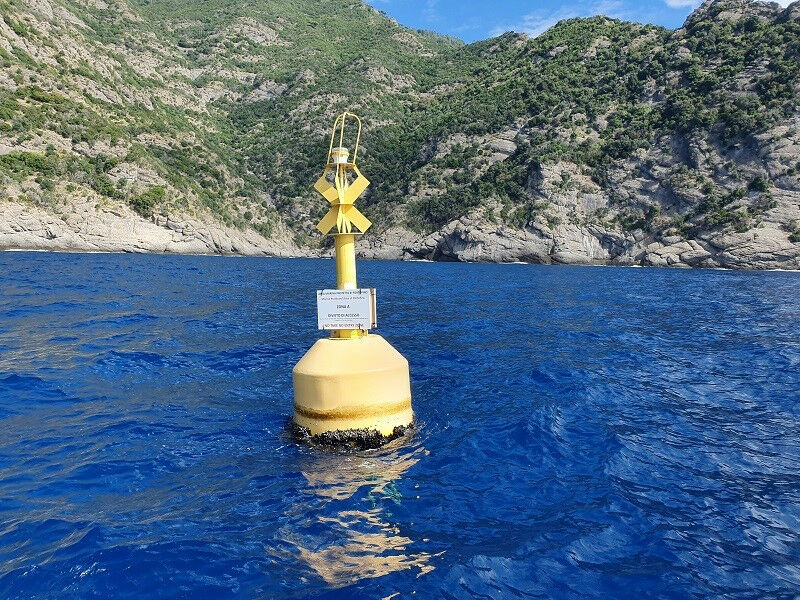
 Buoy delimiting the integral protection zone of the Portofino marine protected area.
Buoy delimiting the integral protection zone of the Portofino marine protected area. Joachim Claudet - Marine protected areas (MPAs) are one of the solutions being put forward to help adapt to and mitigate the effects of climate change. To demonstrate their effectiveness, scientists from CRIOBE (CNRS/École Pratique des Hautes Etudes/UPVD), as part of an international team 1 , analysed 22,403 research articles on MPAs. Their results show that MPAs can significantly improve carbon sequestration, coastal protection, biodiversity and the reproductive capacity of marine organisms, as well as the catches and income of fishers when they are fully or highly protected. Although MPAs cannot solely compensate for the full impact of climate change, they are a valuable tool for the mitigation and adaptation of socio-ecological systems. Joachim Claudet While ocean-related solutions were previously proposed without any real grounding, these results now provide a scientific basis for intergovernmental conventions to address the climate crisis. This new study, published in One Earth on October 21, also reveals that the effect of MPAs on certain climate mechanisms is still not sufficiently documented.
TO READ THIS ARTICLE, CREATE YOUR ACCOUNT
And extend your reading, free of charge and with no commitment.
Your Benefits
- Access to all content
- Receive newsmails for news and jobs
- Post ads