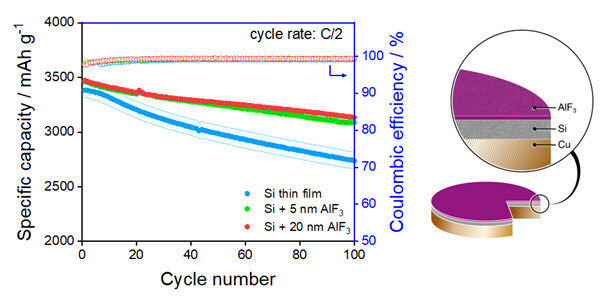
© Wiley-VCH Verlag GmbH & Co. KGaA, Weinheim - In order to exploit the promising potential of silicon (Si) as anode material in lithium-ion batteries (LIBs), it is necessary to overcome existing challenges such as capacity losses during battery operation. A team from MEET Battery Research Center, BACCARA International Graduate School at the University of Münster, and Helmholtz Institute Münster of Forschungszentrum Jülich demonstrated that coating silicon thin-film anodes with aluminum fluoride (AlF
3) leads to an enhanced cycling stability. With their study, the researchers elucidated the mechanism and effects of AlF3 coatings on silicon thin-film anodes and provide important fundamentals on the further path to commercialization of the promising silicon-based lithium-ion batteries. Aluminum Fluoride Coating Impacts Solid Electrolyte Interphase. During the initial charge cycles of LIB cells, the Solid Electrolyte Interphase (SEI) forms on the anode surface. However, Si anodes suffer from abrupt volume changes during lithiation/de-lithiation processes.
TO READ THIS ARTICLE, CREATE YOUR ACCOUNT
And extend your reading, free of charge and with no commitment.
Your Benefits
- Access to all content
- Receive newsmails for news and jobs
- Post ads