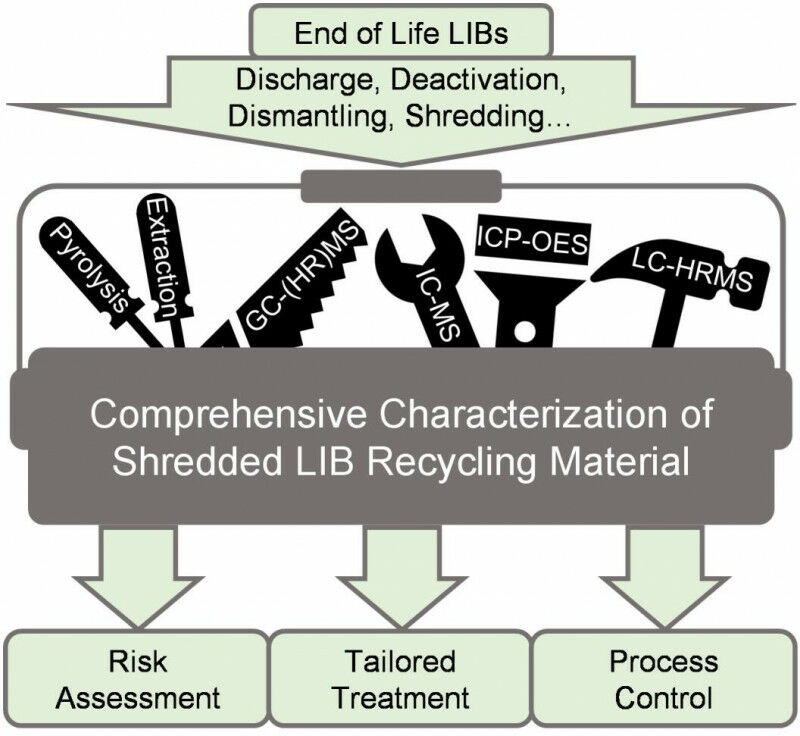
© Chemistry - A European Journal - Compared to laboratory cells or aged but still intact commercial cells, shredded battery materials represent an even more complex sample. Active materials of both electrodes, inactive materials and electrolyte residues cannot be easily analysed separately. In order to understand in detail which materials were originally used in these samples and how the cells have aged, scientists from MEET Battery Research Center at the University of Münster and the Institute for Mechanical Process Engineering and Processing Technology at the Technische Universität (TU) Bergakademie Freiberg have identified a broad spectrum of methods for analysing shredded lithium-ion battery materials. Circular Economy of Batteries. Due to the rapidly growing battery cell production, the return flows of spent lithium-ion batteries will also increase strongly in the near future. To close the circular supply chain of batteries, it is all the more important to comprehensively research the different fields of recycling,- explains MEET scientist Christoph Peschel. -In addition, current recycling materials do not always contain the same battery chemistry.
TO READ THIS ARTICLE, CREATE YOUR ACCOUNT
And extend your reading, free of charge and with no commitment.
Your Benefits
- Access to all content
- Receive newsmails for news and jobs
- Post ads