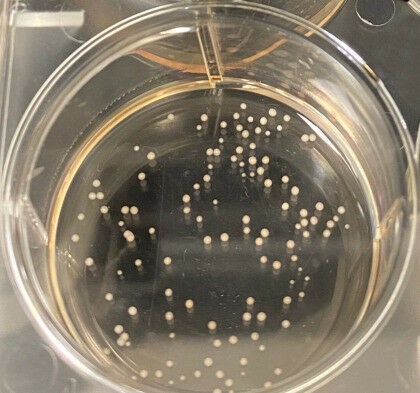
Tiny pale dots in a petri dish
Engineering feat expands the research and testing available to scientists with brain organoids. Tiny pale dots in a petri dish It could be the world's tiniest EEG electrode cap, created to measure activity in a brain model the size of a pen dot. Its designers expect the device to lead to better understanding of neural disorders and how potentially dangerous chemicals affect the brain. This engineering feat, led by Johns Hopkins researchers and detailed in- Science Advances , expands what researchers can accomplish with organoids, including mini brains-the lab-grown balls of human cells that mimic some of a brain's structure and functionality. "This provides an important tool to understand the development and workings of the human brain," said David Gracias , a Johns Hopkins chemical and biomolecular engineer and one of the creators. "Creating micro-instrumentation for mini-organs is a challenge, but this invention is fundamental to new research." Since organoids were first created more than a decade ago, researchers have modified stem cells to create small-scale kidneys, lungs, livers, and brains. The complex, miniature models are used to study how the organs develop.
TO READ THIS ARTICLE, CREATE YOUR ACCOUNT
And extend your reading, free of charge and with no commitment.