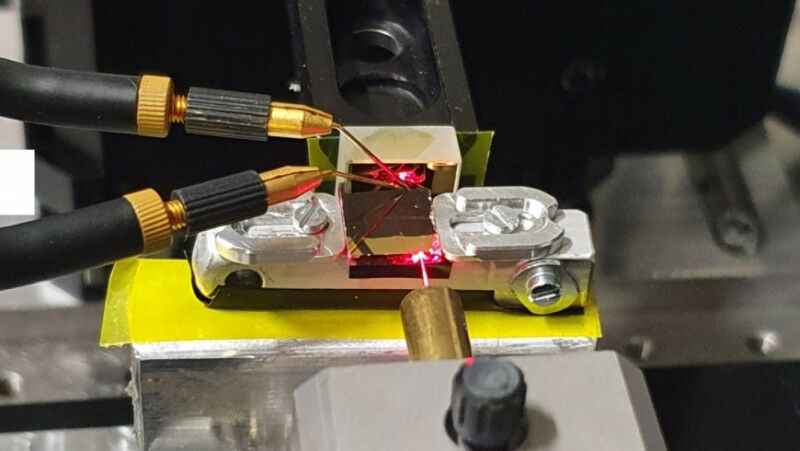
The experimental setup: A red alignment laser was used to visualize the beam path from the fiber into the optical waveguide and its reflection at a gold mirror. Two microprobes were used to contact the photoconductor, the size of which is in the subwavelength range.
The experimental setup: A red alignment laser was used to visualize the beam path from the fiber into the optical waveguide and its reflection at a gold mirror. Two microprobes were used to contact the photoconductor, the size of which is in the subwavelength range. Extreme miniaturization of infrared (IR) detectors is critical for their integration into next-generation consumer electronics, wearables and ultra-small satellites. Thus far, however, IR detectors have relied on bulky (and expensive) materials and technologies. A team of scientists lead by Empa researcher Ivan Shorubalko now succeeded in developing a cost-effective miniaturization process for IR spectrometers based on a quantum dot photodetector, which can be integrated on a single chip, as they report in Nature Photonics. Miniaturization of infrared spectrometers will lead to their wider use in consumer electronics, such as smartphones enabling food control, the detection of hazardous chemicals, air pollution monitoring and wearable electronics. They can be used for the quick and easy detection of certain chemicals without using laboratory equipment.
TO READ THIS ARTICLE, CREATE YOUR ACCOUNT
And extend your reading, free of charge and with no commitment.