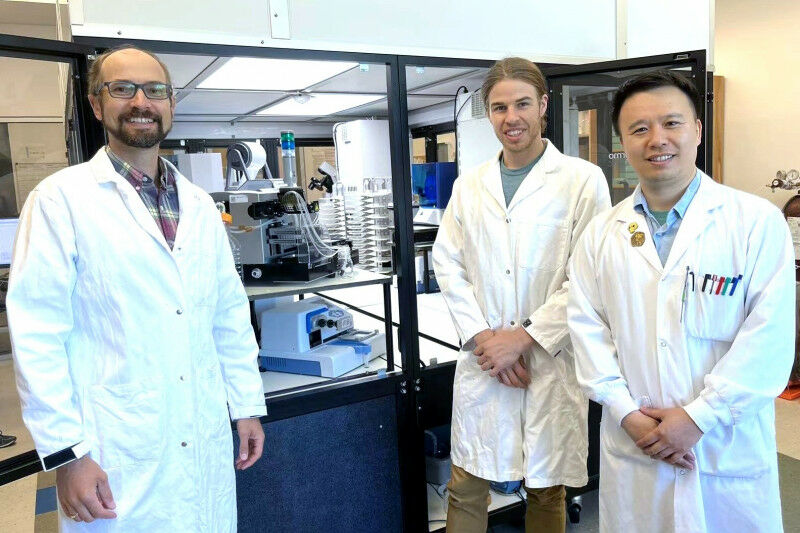
Lef to Right: David Vocadlo, Matthew Deen, Yanping Zhu Credit: SFU
Lef to Right: David Vocadlo, Matthew Deen, Yanping Zhu Credit: SFU Researchers are a step closer to understanding how Parkinson's disease develops and progresses thanks to chemical biological tools developed at Simon Fraser University. New research, published this week in the Proceedings of the National Academy of Sciences of the USA, and spearheaded by SFU researchers Matthew Deen and Yanping Zhu, outlines new technology and methods to measure the activity of lysosomal glucocerebrosidase (GCase), an enzyme that is commonly linked to Parkinson's disease. Parkinson's is the second most common neurodegenerative disease and can cause symptoms including tremors, muscle stiffness, and impaired balance and coordination that worsen over time. While the exact causes of Parkinson's are not fully understood, low GCase activity is known to contribute to the disease and a better understanding of this enzyme could lead to improved diagnostics and treatment. The team's findings show that the activity of this enzyme in patients is similar in both blood cells and brain cells, which could potentially enable researchers and medical professionals to monitor how Parkinson's progresses in the brain using blood samples. -This is the first approach that has been shown to reliably and accurately report on the activity of this enzyme directly within lysosomes of living cells,- says Chemistry and Molecular Biology and Biochemistry professor David Vocadlo, one of the study co-authors. -Being able to measure the lysosomal activity of this enzyme in an accurate way could be very helpful in understanding the root causes of Parkinson's as well as potentially helping to diagnose or track its progression.
TO READ THIS ARTICLE, CREATE YOUR ACCOUNT
And extend your reading, free of charge and with no commitment.