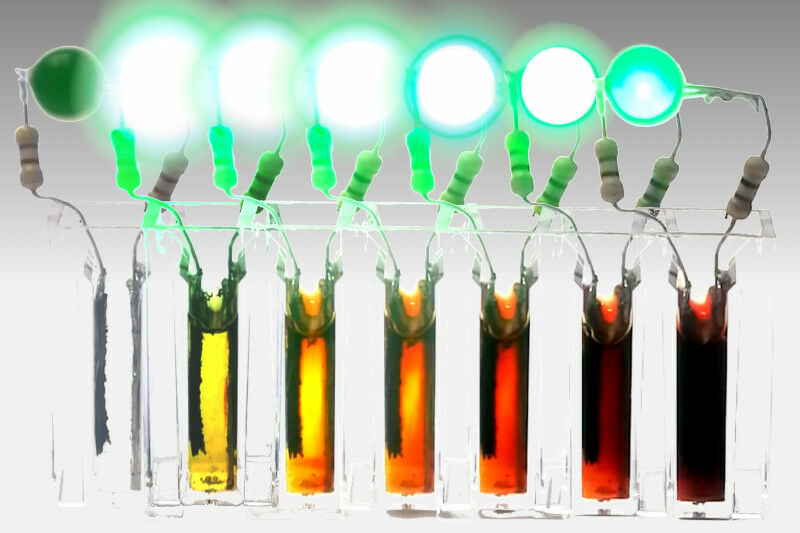
Time-lapse series of images shows the new type of battery becoming fully discharged over a period of days. In the process of discharging, the new ’catholyte’ material in the battery cell gets chemically coverted into a reddish compound, so the color gets darker the more it discharges. Credits : Image: Courtesy of the researchers
Time-lapse series of images shows the new type of battery becoming fully discharged over a period of days. In the process of discharging, the new 'catholyte' material in the battery cell gets chemically coverted into a reddish compound, so the color gets darker the more it discharges. Credits : Image: Courtesy of the researchers Pacemakers and other medical devices, as well as long-distance drones and remote sensors, could require fewer battery replacements with new approach. For the last few decades, battery research has largely focused on rechargeable lithium-ion batteries, which are used in everything from electric cars to portable electronics and have improved dramatically in terms of affordability and capacity. But nonrechargeable batteries have seen little improvement during that time, despite their crucial role in many important uses such as implantable medical devices like pacemakers. Now, researchers at MIT have come up with a way to improve the energy density of these nonrechargeable, or "primary," batteries. They say it could enable up to a 50 percent increase in useful lifetime, or a corresponding decrease in size and weight for a given amount of power or energy capacity, while also improving safety, with little or no increase in cost.
TO READ THIS ARTICLE, CREATE YOUR ACCOUNT
And extend your reading, free of charge and with no commitment.