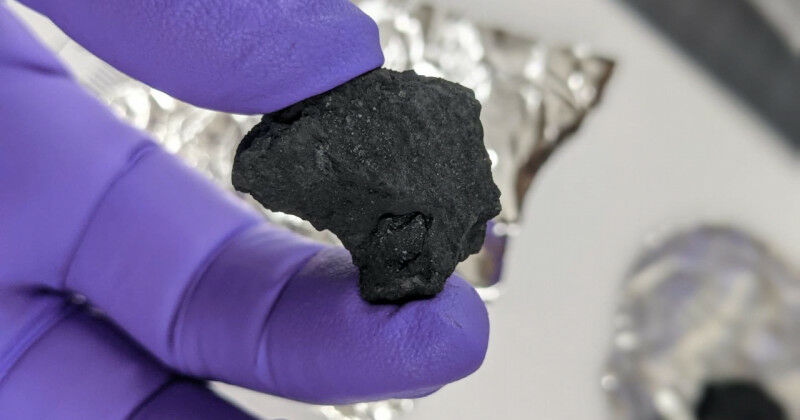
Fragment of Winchcombe meteorite held by researcher. (The Trustees of the Natural History Museum, London)
Fragment of Winchcombe meteorite held by researcher. (The Trustees of the Natural History Museum, London) - The Winchcombe meteorite, a rare carbonaceous meteorite which crashed onto a driveway in Gloucestershire in 2021, has been found to contain extra-terrestrial water and organic compounds that reveal insights into the origin of Earth's oceans. A new study, published today by Science Advances , led by experts from the Natural History Museum and the University of Glasgow reports the orbital history and first laboratory analyses of the Winchcombe meteorite, which was recovered only hours after its spectacular fireball lit up the skies over the U.K. in February 2021. Denis Vida Denis Vida, a Western physics and astronomy postdoctoral associate, was a key contributor to the study. Combining data from five different meteor networks that exist in the U.K. and applying the unique expertise and software that exists at Western, Vida studied the Winchcombe object and can now confirm that it is the carbonaceous meteorite with the best observed orbit in history, and one of the best among all meteorites. "These techniques and technologies allowed us to pinpoint exactly where this object originated," said Vida, a member of Western's Institute for Earth and Space Exploration. "We developed a new method which allows us to combine both professional and amateur observations.
TO READ THIS ARTICLE, CREATE YOUR ACCOUNT
And extend your reading, free of charge and with no commitment.