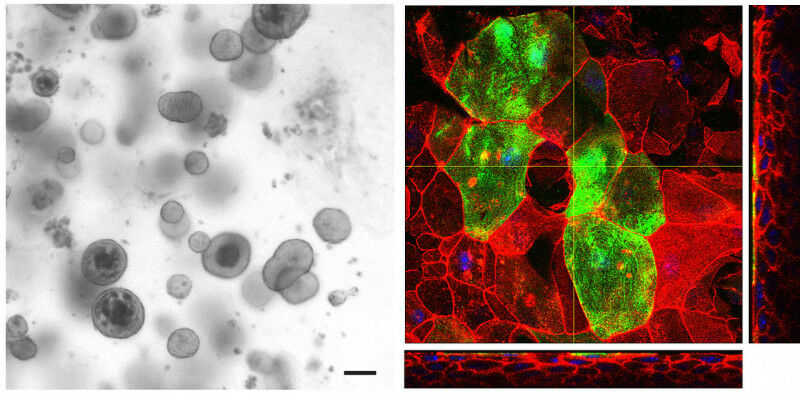
Organoid-based models: bladder organoids (left image) are used to develop a more sophisticated bladder organoid-derived model (right image) containing differentiated superficial umbrella cells (in green) and multiple cell layers underneath, mimicking the bladder epithelium. Uroplakin 3a in green, actin in red, and nuclei in blue. (Image: Carmen Aguilar)
Organoid-based models: bladder organoids ( left image ) are used to develop a more sophisticated bladder organoid-derived model ( right image ) containing differentiated superficial umbrella cells ( in green ) and multiple cell layers underneath, mimicking the bladder epithelium. Uroplakin 3a in green, actin in red, and nuclei in blue. (Image: Carmen Aguilar) 05/18/2022 - The German government is providing about 2.4 million Euros for a new research group in infectious diseases at JMU Würzburg. Dr. Carmen Aguilar will use this grant to search for new therapeutic approaches against one of the most common and recurrent bacterial infections. About every second woman gets a urinary tract infection once in her life, the cause for which is most often the uropathogenic bacterium Escherichia coli (UPEC). Overuse of antibiotics in the last four decades has led to bacterial strains including UPEC becoming resistant to commonly used antibiotics. Thus, new alternative treatment options are urgently needed.
TO READ THIS ARTICLE, CREATE YOUR ACCOUNT
And extend your reading, free of charge and with no commitment.