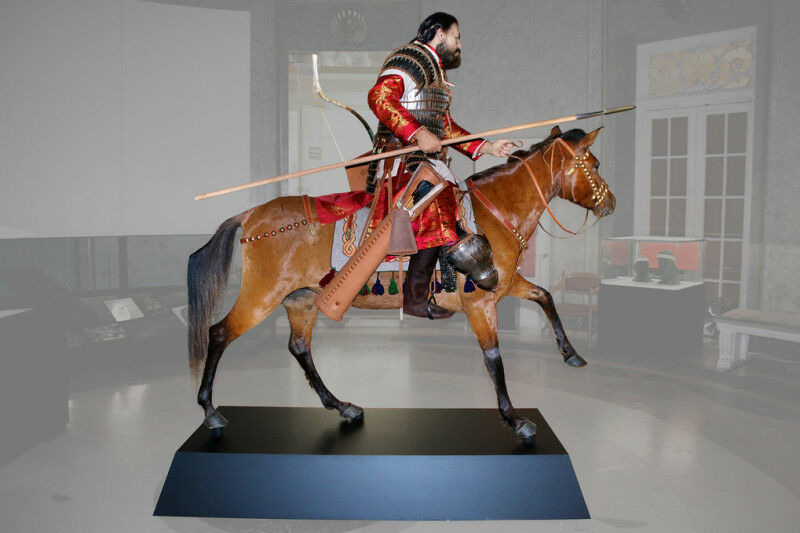
 Reconstruction of an Avar-period armoured horseman based on Grave 1341/1503 of the Derecske-Bikás-dulo site (Déri Museum, Debrecen).
Reconstruction of an Avar-period armoured horseman based on Grave 1341/1503 of the Derecske-Bikás-dulo site (Déri Museum, Debrecen). Ilona C. Kiss - Multidisciplinary research team sheds light on the 1,400-year-old mystery about the genetic origins of the Avar elite Less known than Attila's Huns, the Avars were their more successful successors. They ruled much of Central and Eastern Europe for almost 250 years. We know that they came from Central Asia in the sixth century CE, but ancient authors and modern historians debated their provenance. Now, a multidisciplinary research team of geneticists, archaeologists and historians, including researchers from the Max Planck Institute for Evolutionary Anthropology in Leipzig, Germany, obtained and studied the first ancient genomes from the most important Avar elite sites discovered in contemporary Hungary. This study traces the genetic origin of the Avar elite to a faraway region of East Central Asia. It provides direct genetic evidence for one of the largest and most rapid long-distance migrations in ancient human history. In the 560s, the Avars established an empire that lasted more than 200 years, centered in the Carpathian Basin. Despite much scholarly debate their initial homeland and origin has remained unclear. They are primarily known from historical sources of their enemies, the Byzantines, who wondered about the origin of the fearsome Avar warriors after their sudden appearance in Europe. Had they come from the Rouran empire in the Mongolian steppe (which had just been destroyed by the Turks), or should one believe the Turks who strongly disputed such a prestigious legacy?
TO READ THIS ARTICLE, CREATE YOUR ACCOUNT
And extend your reading, free of charge and with no commitment.
Your Benefits
- Access to all content
- Receive newsmails for news and jobs
- Post ads


