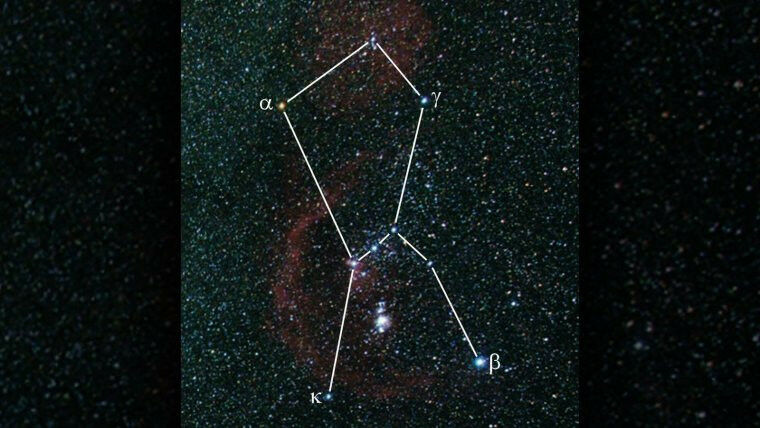
The constellation Orion, Betelgeuse is marked with Alpha. Image: Markus Mugrauer
The constellation Orion, Betelgeuse is marked with Alpha. Image: Markus Mugrauer With progressing nuclear fusion in the center of a star, brightness, size, and color also change. Astrophysicists can derive from such properties important information on age and mass of a star. Those stars with significantly more mass than our Sun are blue-white or red - the transition from red via yellow and orange is relative rapid for astronomical time-scales. Astrophysicists of Friedrich Schiller University Jena, Germany, together with colleagues of other subjects from the USA and Italy, have now been successful to detect and date such a color change in a bright star. With several historical sources, they found that Betelgeuse - the bright red giant star in the upper left of the constellation Orion - was yellow-orange some 2,000 years ago. They report about their results in the current issue of ,,Monthly Notices of the Royal Astronomical Society". Still 1.5 million years to go until Betelgeuse explodes as supernova. Astronomer Ralph Neuhäuser from Jena includes historical celestial observations in his astrophysical research since some ten years - this field is called ,,Terra-Astronomy". He closely collaborates with colleagues from languages, history, and natural philosophy - including his wife Dagmar. " The view back in time delivers strong impulses and important results ", Neuhäuser adds. " There are quite a number of astrophysical problems which can hardly be solved without historical observations. " What do those historical transmissions tell us about Betelgeuse?
TO READ THIS ARTICLE, CREATE YOUR ACCOUNT
And extend your reading, free of charge and with no commitment.