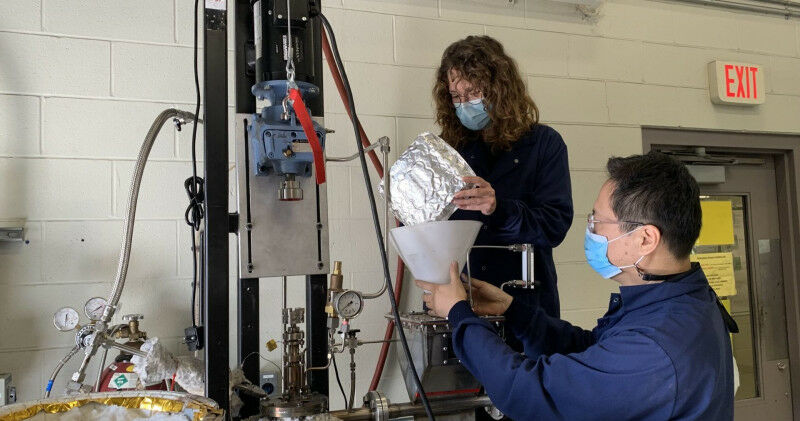
Western Engineering PhD candidate Maddalena Laghezza fills the hopper of the pilot plant used for PFAS destruction, assisted by ICFAR technology specialist Lu Liu. Photo by Franco Berruti
Western Engineering PhD candidate Maddalena Laghezza fills the hopper of the pilot plant used for PFAS destruction, assisted by ICFAR technology specialist Lu Liu. Photo by Franco Berruti - Researchers at Western's Institute for Chemicals and Fuels from Alternative Resources (ICFAR) a nd collaborators from academia, government and industry are identifying and treating 'forever chemicals' in water systems, an ever-increasing environmental concern which affects more than 2.5 million Canadians. Forever chemicals, the common name for perand polyfluoroalkyl substances (PFAS), are a new class of more than 4,000 environmental contaminants whose impact on human health is yet unknown. PFAS are used in a wide range of products such as cosmetics, textiles, fire-fighting foams and food packaging materials. Western chemical engineering professor Franco Berruti and his colleagues at ICFAR are already making considerable advances for destroying PFAS in biosolids by using thermochemical treatment (pyrolysis) and in water by applying ultraviolet (UV) treatment. Now, new funding from Natural Sciences and Engineering Research Council (NSERC) will push the research even further. This collaborative University of Waterloo-Western research project will determine which PFAS are present in Ontario waters, determine the chemical and physical processes underpinning treatment technologies, and provide key information to inform Canadian water systems of potential PFAS contaminants and treatment options.
TO READ THIS ARTICLE, CREATE YOUR ACCOUNT
And extend your reading, free of charge and with no commitment.