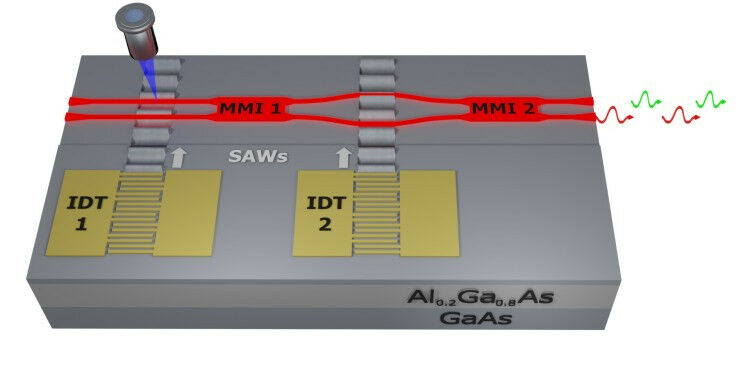
 A focused laserbeam (left, blue) generates single photos by a single quantum dot inside the photonic waveguides (red), which are fabricated on top of crystalline gallium arsenide- (GaAs-) aluminium gallium arsenide (Al0.2Ga0.8As).Two interdigitating electrodes (interdigital transducers, IDT) generate nanoscale soundwaves (surface acoustic waves, SAWs), which dynamically strain the waveguides. The nanoscale soundwave generated by the left IDT switches the color of the emitted single photons. The two waveguides are coupled by two so-called multimode interference beamsplitters (MMIs). The soundwave generated by the right IDT sorts the single photons according to their colour (red and green) between the two outputs on the right.
A focused laserbeam (left, blue ) generates single photos by a single quantum dot inside the photonic waveguides ( red ), which are fabricated on top of crystalline gallium arsenide- (GaAs-) aluminium gallium arsenide (Al0.2Ga0.8As).Two interdigitating electrodes (interdigital transducers, IDT) generate nanoscale soundwaves (surface acoustic waves, SAWs), which dynamically strain the waveguides. The nanoscale soundwave generated by the left IDT switches the color of the emitted single photons. The two waveguides are coupled by two so-called multimode interference beamsplitters (MMIs). The soundwave generated by the right IDT sorts the single photons according to their colour (red and green) between the two outputs on the right. Dominik Bühler A team of German and Spanish researchers from Valencia, Münster, Augsburg, Berlin and Munich have succeeded in controlling individual light quanta to an extremely high degree of precision. In the "Nature Communications" journal, the researchers report how, by means of a soundwave, they switch individual photons on a chip back and forth between two outputs at gigahertz frequencies. This method, demonstrated here for the first time, can now be used for acoustic quantum technologies or complex integrated photonic networks.
TO READ THIS ARTICLE, CREATE YOUR ACCOUNT
And extend your reading, free of charge and with no commitment.
Your Benefits
- Access to all content
- Receive newsmails for news and jobs
- Post ads