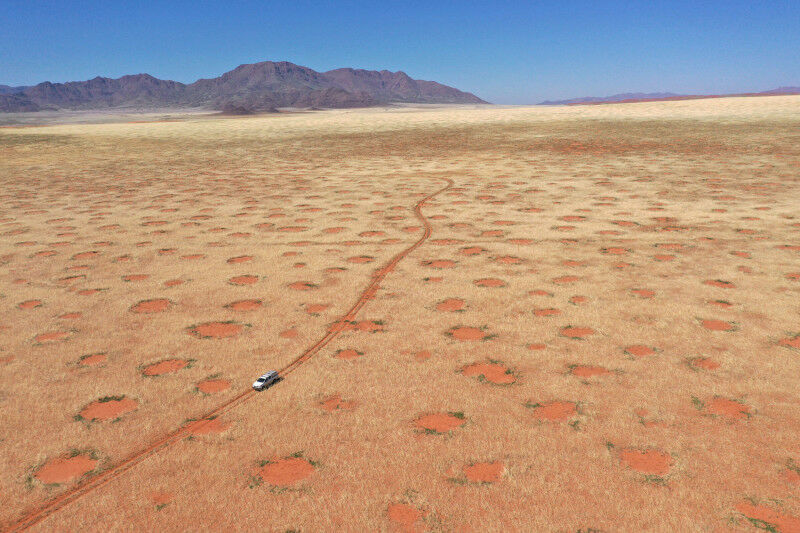
Drone image of car driving through the NamibRand Nature Reserve, one of the fairy-circle regions in Namibia where the researchers undertook grass excavations, soil-moisture and infiltration measurements (April 2022). Photo: Dr Stephan Getzin
Drone image of car driving through the NamibRand Nature Reserve, one of the fairy-circle regions in Namibia where the researchers undertook grass excavations, soil-moisture and infiltration measurements (April 2022). Photo: Dr Stephan Getzin Researchers led by Göttingen University show that plant water stress not termites causes mysterious circles Scientists have puzzled over the origin of Namibia's fairy circles for nearly half a century. It boiled down to two main theories: either termites were responsible, or plants were somehow self-organizing. Now, researchers from the University of Göttingen, benefitting from two exceptionally good rainfall seasons in the Namib Desert, show that the grasses within the fairy circles died immediately after rainfall, but termite activity did not cause the bare patches. Instead, continuous soil-moisture measurements demonstrate that the grasses around the circles strongly depleted the water within the circles and thereby likely induced the death of the grasses inside the circles. The results were published in Perspectives in Plant Ecology, Evolution and Systematics . About 80'140 kilometres from the coast in the Namib, there are millions of fairy circles - circular gaps in the grassland, each a few meters wide, together forming a distinctive pattern across the whole landscape and visible for miles around.
TO READ THIS ARTICLE, CREATE YOUR ACCOUNT
And extend your reading, free of charge and with no commitment.