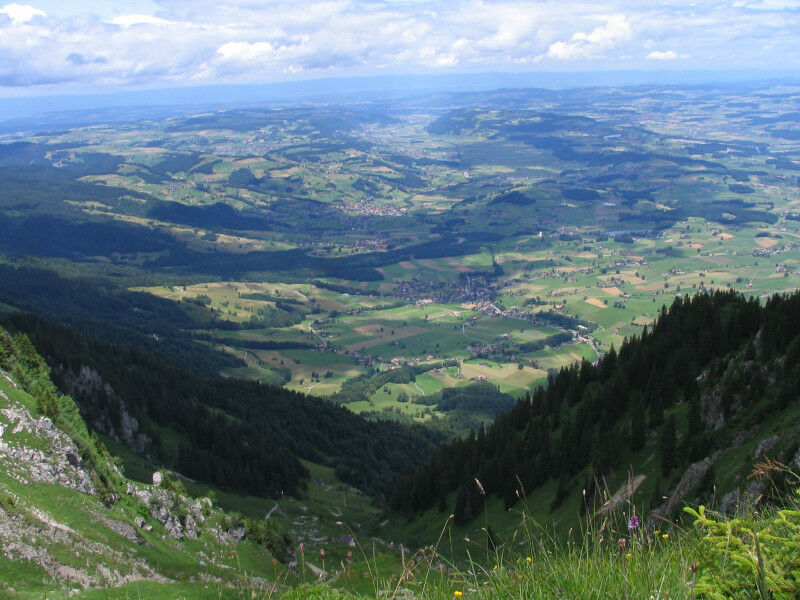
View of the Gürbe valley. A team led by the University of Bern was able to document the occurrence of a 155 meters deep so-called overdeepening beneath the present surface filled with debris and lake deposits. Wikimedia commons
View of the Gürbe valley. A team led by the University of Bern was able to document the occurrence of a 155 meters deep so-called overdeepening beneath the present surface filled with debris and lake deposits. Wikimedia commons A team led by the University of Bern was able to proof that the glaciers of the penultimate ice age ('Riss' glaciation) mainly eroded the bedrock between Thun and Bern, but that during the last glaciation (' Würm'- glaciation) glacial carving resulted in a widening and not in a further deepening of the valleys. The researchers reconstructed the geometry of the bedrock using gravity measurements to reach their conclusions. The glacial cycles repeat themselves every hundred thousand years. This was also the case during the recent geological past in the Alpine region. During the 'Riss' Ice Age, between 200,000 and 150,000 years ago, the glaciers advanced far into the Swiss Plateau and shaped the landscape. The same occurred during the 'Würm' glaciation between 100,000 and 20,000 years ago, when several smaller ice advances and then the large glaciers 20,000 years ago led to a further change of our landscape. These ice masses not only sculpted the hills and the mountains, they also resulted in the formation of valleys and gorges several hundred meters deep, the so-called over-deepenings. These were then covered with gravel and debris after the glaciers retreated, and therefore they are hidden under the present surface. The city of Bern is built on such an underground valley system. The same is also the case for the Aare and Gürbetal valleys. There the bedrock is hidden up to 200 meters below the valley floor. What do these valleys look like now?
TO READ THIS ARTICLE, CREATE YOUR ACCOUNT
And extend your reading, free of charge and with no commitment.