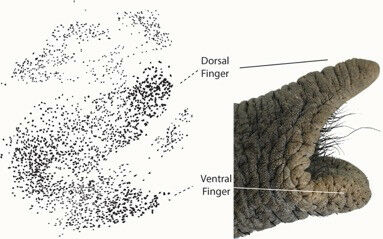
Nerve cells in the African elephant’s facial motor nucleus (left). The facial nucleus is the brain structure, which controls the muscles of the face. Trunk tip of an African elephant with the two trunk fingers (right). The ’trunk-finger’ representation stands out in the elephant’s brain. Source: Science Advances
Nerve cells in the African elephant's facial motor nucleus ( left ). The facial nucleus is the brain structure, which controls the muscles of the face. Trunk tip of an African elephant with the two trunk fingers ( right ). The 'trunk-finger' representation stands out in the elephant's brain. Source: Science Advances Berlin scientists decipher facial motor control in elephants Elephants have an amazing arsenal of face, ear and trunk movements. The trunk consists of far more muscles than the entire human body and can perform both powerful and very delicate movements. A team of scientists from the Humboldt University of Berlin and the Leibniz Institute for Zoo and Wildlife Research (Leibniz-IZW) now examined the facial motor nucleus of African and Asian elephants, the brain structure that controls the facial muscles of these animals.
TO READ THIS ARTICLE, CREATE YOUR ACCOUNT
And extend your reading, free of charge and with no commitment.