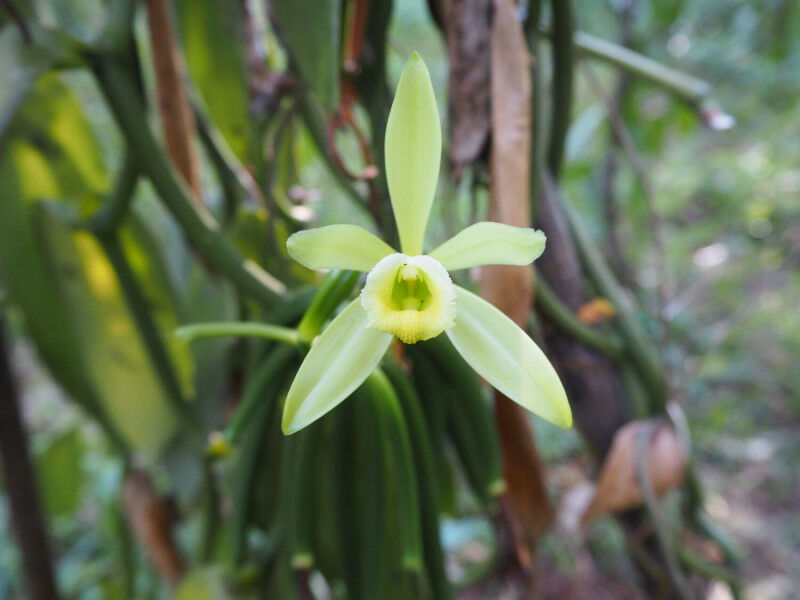
Vanilla in flower Photo: University of Göttingen
Vanilla in flower Photo: University of Göttingen Research at German and Malagasy Universities highlights opportunities for smallholder farmers and conservation How can biodiversity be preserved whilst securing the economic livelihood of smallholder farmers growing vanilla in Madagascar? There is a way, according to a study by the Universities of Göttingen, Marburg and Hohenheim. The research team shows that vanilla plantations established on fallow land do not differ in terms of yield from those established in the forest. Cultivation on fallow land also increases biodiversity there. The results were published in Nature Communications . Collecting data on Madagascar Photo: University of Göttingen - In this study, researchers recorded crop yields in vanilla agroforestry systems in northeastern Madagascar, the world's largest vanilla-growing area, which is dominated by smallholder farmers. They related these results to the biodiversity as identified by trees, herbaceous plants, birds, amphibians, reptiles, butterflies and ants. The economic and ecological aspects of cultivation were combined.
TO READ THIS ARTICLE, CREATE YOUR ACCOUNT
And extend your reading, free of charge and with no commitment.