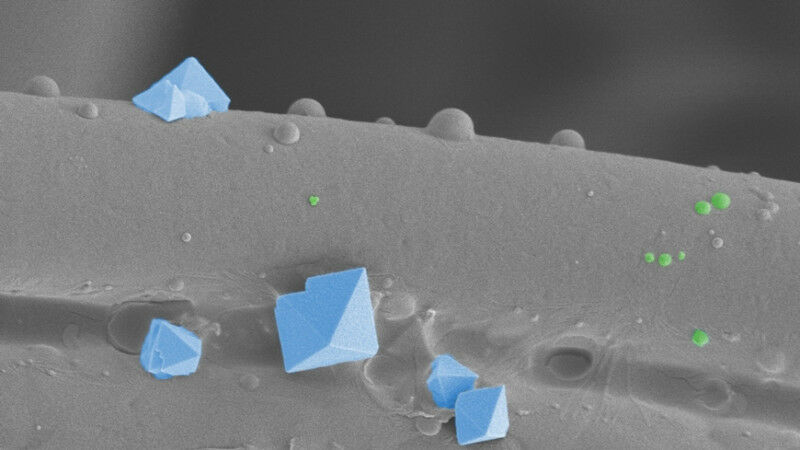
Only a few viruses make it to the innermost layer of a fabric mask. The picture shows a textile fiber with salt crystals (light blue) and viruses about 100 nanometers in size (green). (Scanning electron microscopy, colored) Image: Empa
Only a few viruses make it to the innermost layer of a fabric mask. The picture shows a textile fiber with salt crystals ( light blue ) and viruses about 100 nanometers in size ( green ). (Scanning electron microscopy, colored) Image: Empa - Using a new analytical method, researchers have tracked viruses as they pass through face masks and compared their failure on the filter layers of different types of masks. The new method should now accelerate the development of surfaces that can kill viruses, the team writes in the journal Scientific Reports. Using high pressure, the apparatus pushes artificial saliva fluid, colored in red, with test particles through a stretched mask. This is how the researchers simulate the process of a droplet infection. The new method established at Empa is currently used by certified test centers to ensure the quality of textile face masks because a safe and effective protective mask must meet demanding requirements: It must keep out germs, withstand splashing drops of saliva, and at the same time allow air to pass through.
TO READ THIS ARTICLE, CREATE YOUR ACCOUNT
And extend your reading, free of charge and with no commitment.