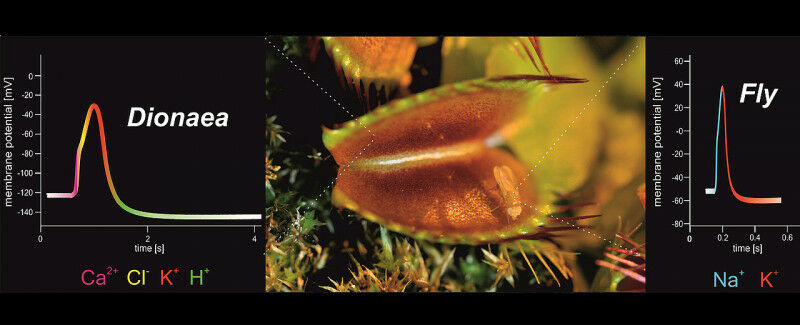
A Venus flytrap with its prey (center): When the fly comes close to the sensory hairs, an action potential (AP) is triggered in the Venus flytrap (left). Compared to the animal AP of the fly (right), distinctly different ion fluxes are involved in the different APs.
A Venus flytrap with its prey ( center ): When the fly comes close to the sensory hairs, an action potential (AP) is triggered in the Venus flytrap ( left ). Compared to the animal AP of the fly ( right ), distinctly different ion fluxes are involved in the different APs. The Venus flytrap relies on glutamate receptors to catch prey by transmitting corresponding stimuli electrically. A research team at the University of Würzburg has now explained the underlying molecular mechanism. To hunt flies and other small animals, the Venus flytrap has to be faster than its prey. To do so, it has developed a catching organ that can snap shut in a fraction of a second and is controlled by the fastest signaling networks known in plants. An electrical signal known as the action potential is at the heart of this network.
TO READ THIS ARTICLE, CREATE YOUR ACCOUNT
And extend your reading, free of charge and with no commitment.