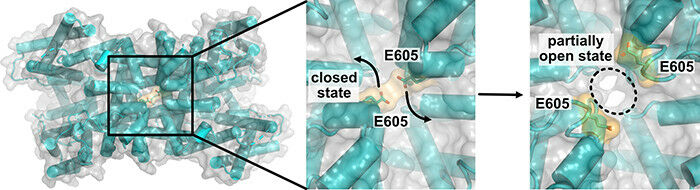
3-Dimensional sketch of the TPC1 channel protein looking at the vacuolar pore entrance from above. Positional changes of amino acid residues such as E605 during the transition from a closed channel state to a partially open pore state. (Image: Thomas Müller)
3-Dimensional sketch of the TPC1 channel protein looking at the vacuolar pore entrance from above. Positional changes of amino acid residues such as E605 during the transition from a closed channel state to a partially open pore state. (Image: Thomas Müller) - In humans, only nerves and muscle cells are electrically excitable, whereas in plants almost all cells are. This is due to a sophisticated mechanism in an ion channel of the vacuole. Plant cells use electrical signals to process and transmit information. In 1987, as a postdoc of Erwin Neher in Göttingen, biophysicist Rainer Hedrich discovered an ion channel in the central vacuole of the plant cell, which is activated by calcium and electrical voltage, using the patch-clamp technique (Nobel Prize for Neher and Sakmann 1991). In 2019, Hedrich's team at Julius-Maximilians-Universität Würzburg (JMU) identified this TPC1 channel as an important element for electrical communication in plants.
TO READ THIS ARTICLE, CREATE YOUR ACCOUNT
And extend your reading, free of charge and with no commitment.