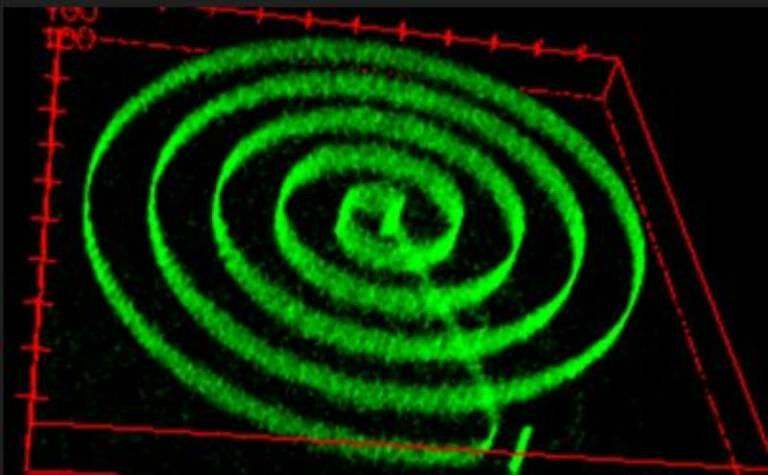
Bioprinting in hydrogels - Credit: Urciuolo and Giobbe et al
Bioprinting in hydrogels - Credit: Urciuolo and Giobbe et al Scientists from across UCL, Great Ormond Street Hospital and the University of Padova have shown how 3D printing can be achieved inside 'mini-organs' growing in hydrogels, which could help better understand how cancer spreads through different tissues. The new technique can help control the shape and activity of the mini-organs, and even force tissue to grow into 'moulds'. The researchers hope that this will allow teams to produce realistic models of organs and disease, and study cells and organs more accurately. Organoid science is a particularly promising area of research at the Zayed Centre for Research (a partnership between the UCL Great Ormond Street Institute for Child Health and Great Ormond Street Hospital). It involves the creation of micro-versions of organs such as the stomach, intestines and lungs. However, the tissue almost always grows in an uncontrolled way and doesn't represent the complex structure of naturally occurring organs. This is particularly important as an organ's shape and structure is as crucial as its cellular makeup.
TO READ THIS ARTICLE, CREATE YOUR ACCOUNT
And extend your reading, free of charge and with no commitment.