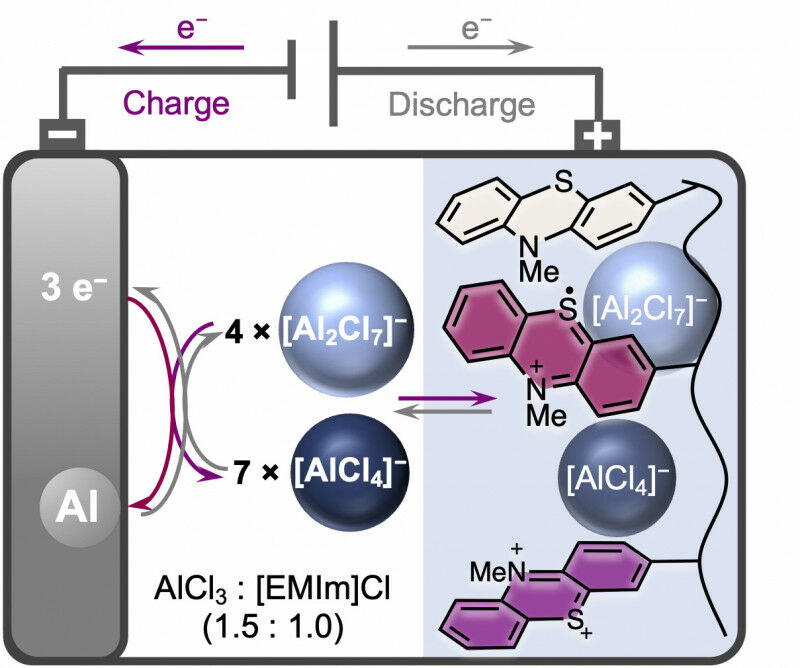
The schematic diagram of the battery shows the redox process in which the electrode material is oxidized and aluminate anions are deposited. Photo credit: Birgit Esser (CC BY-NC 3.0)
The schematic diagram of the battery shows the redox process in which the electrode material is oxidized and aluminate anions are deposited. Photo credit: Birgit Esser (CC BY-NC 3. Research team develops organic redox polymer as positive electrode material for aluminium-ion batteries Aluminium-ion batteries are seen as a promising alternative to conventional batteries that use scarce and difficult-to-recycle raw materials such as lithium. This is because aluminium is one of the most common elements in the Earth's crust, is easier to recycle, and is also safer and less expensive than lithium. However, the development of such aluminium-ion batteries is still in its infancy, as suitable electrode materials that provide sufficient storage capacity are still lacking. A research team headed by Gauthier Studer and led by Birgit Esser of the University of Ulm and Ingo Krossing as well as Anna Fischer of the University of Freiburg has now developed a positive electrode material consisting of an organic redox polymer based on phenothiazine. In the experiment, aluminium batteries with this electrode material stored a previously unattained capacity of 167 milliampere hours per gram (mAh/g).
TO READ THIS ARTICLE, CREATE YOUR ACCOUNT
And extend your reading, free of charge and with no commitment.