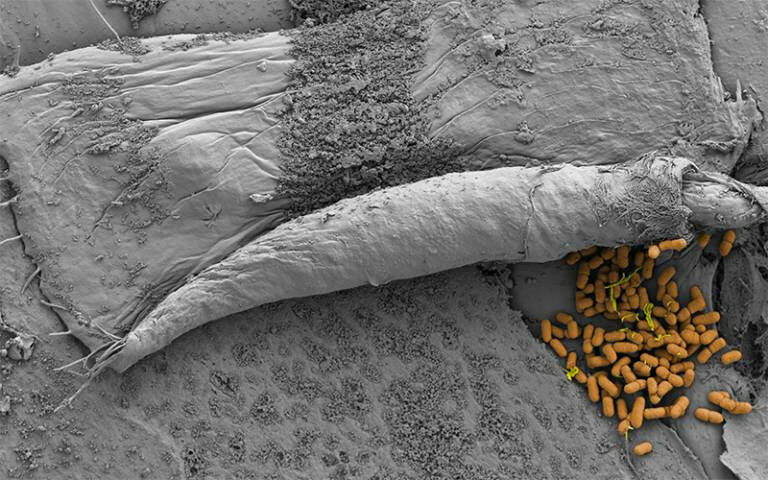
Artificial bladders shine light on bugs that cause urinary tract infections - Bacteria hiding beneath exfoliating bladder epithelium. Credit: Carlos Flores & Jennifer Rohn.
Artificial bladders shine light on bugs that cause urinary tract infections - Bacteria hiding beneath exfoliating bladder epithelium. Credit: Carlos Flores & Jennifer Rohn. A new study led by UCL researchers reveals that numerous bacterial strains are capable of hiding in the human bladder wall, suggesting why urinary tract infections often persist after treatment. The research, published today in Science Advances , is the first to use a sophisticated human tissue model to explore the interaction between host and pathogen for six common species that cause urinary tract infections. The findings suggest that the 'one size fits all' approach to diagnosis and treatment currently used in most healthcare systems is inadequate. Urinary tract infection (UTI) is a growing problem, with around 400 million global cases per year and an estimated 250,000 UTI-related deaths associated with antimicrobial resistance (AMR). Although UTI is often perceived as a simple bacterial infection, 25-30% of UTIs recur within six months despite antibiotic therapy for reasons that are poorly understood.
TO READ THIS ARTICLE, CREATE YOUR ACCOUNT
And extend your reading, free of charge and with no commitment.